

There is a hill, a windy Sunday, and a woman turning to look at the painter. She carries a pale parasol and a veil lifted by the air. Lower down, among the grass, a little boy peeks out. No one speaks in the painting, yet everything moves: the clouds, the dress, the grass bending as if the sky were breathing.
The woman is Camille Doncieux, wife of Claude Monet. The boy is Jean, their son. The year is 1875, and no one yet knows that this scene will become one of the most beloved images of Impressionism. Still less that eleven years later Monet would return to that same hill, the same wind, the same parasol, but with one difference that changes everything: there would be no face.
A Hill in Argenteuil
Argenteuil was then a village on the banks of the Seine, a few kilometers from Paris, and Monet lived there painting almost without rest. Together with other artists of his generation, he defended an idea that at the time seemed heresy: painting had to leave the studio and go out in search of true light, the kind that changes from minute to minute.
Camille had belonged to that world long before becoming his wife. She had been his model when she was very young, and they married in 1870. Jean, the couple's first child, had been born in 1867. She appears in dozens of Monet's canvases: in the garden, on the riverbank, under the trees, in dresses of every color. For the painter, Camille was also a way of seeing.
In the 1875 painting, Monet did not place himself in front of them, but below, on the slope. That is why the figures stand out against the sky. It is a detail that transforms everything: we do not see a lady posing, we see someone passing by, someone the wind is about to carry away. The brushstrokes are quick, loose, almost impatient, because what Monet pursues is not a portrait but an instant. Camille's face, light and barely sketched, can be sensed through the veil. Jean, lower down, is half hidden among the flowers.
The work is known today as Woman with a Parasol, Madame Monet and Her Son, though it is also called The Stroll. It is a family scene, intimate and unceremonious. Nothing in it foretells a farewell.
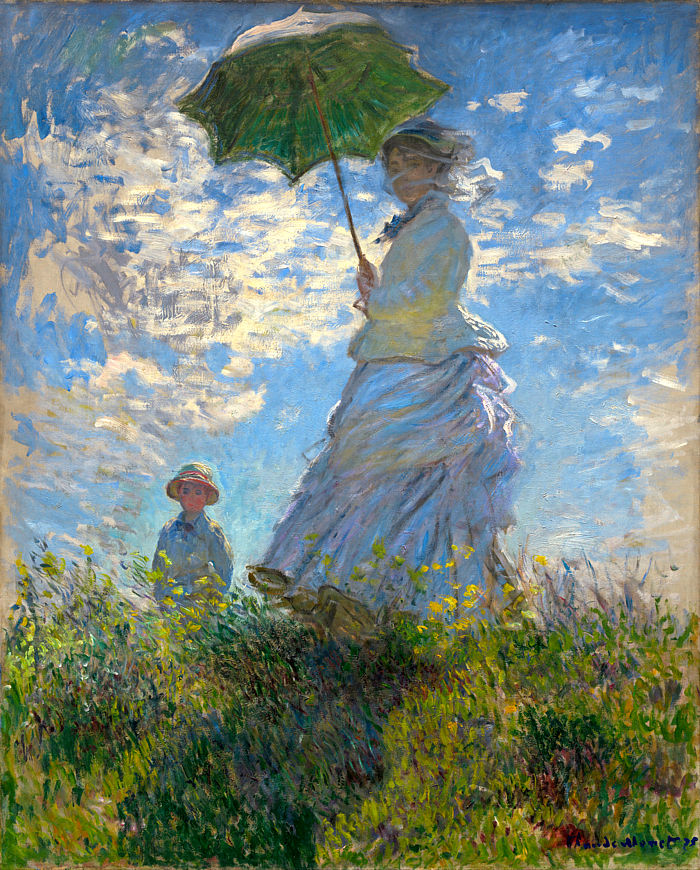
Woman with a Parasol, Claude Monet, France, 1875, National Gallery of Art, Washington, D.C.
What Monet Saw Beside the Bed
Four years later, in September 1879, Camille died. She was thirty-two years old and left behind two young children. The family was then living in Vétheuil, in a house shared with the Hoschedé family, and the preceding years had been hard, with debts, moves, and an illness that dragged on.
What happened next we know through Georges Clemenceau, a friend of Monet and a future statesman, who recounted it many years later. According to his account, Monet confessed something he never forgot: while keeping vigil over Camille, he caught himself observing her face as a painter. He found himself analyzing, almost involuntarily, the tones that death was leaving on her skin: the blues, the grays, the yellows. And he was horrified at himself. The natural, human thing would have been to have eyes only for mourning her.
That morning he painted the portrait now called Camille on Her Deathbed. It is an almost formless canvas, a veil of blues and whites in which the face seems to dissolve. It is hard to look at it without thinking that Monet, as he painted it, was doing two things at once: saying goodbye and being unable to stop looking.
It is important to remember that this is the only thing that is documented: what he himself told. The rest are interpretations, and interpretations should be treated for what they are.
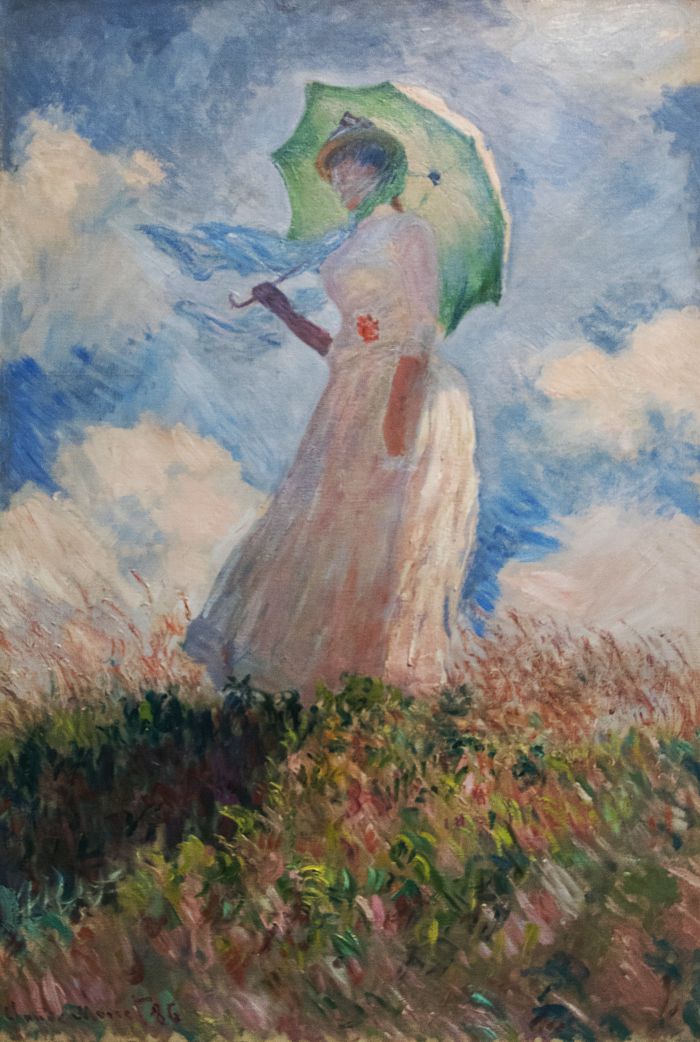
Woman with a Parasol Turned to the Left, 1886. Musée d'Orsay, Paris.
Seven Years Later
Monet carried on, as people do who have no other choice. In 1883 he settled in Giverny, a village with which he would link his name forever, with Alice Hoschedé and the children of both households under one roof. There he began to build the garden that would later give him his famous water lilies.
In 1886, seven years after Camille's death, he painted a woman with a parasol on a hilltop once again. And he did not paint one, but two.
Both canvases are now in the Musée d'Orsay in Paris, which holds them under the title studies of a figure in the open air. In one, the woman turns to the left. In the other, to the right. At first glance they look like the same scene seen in a mirror, but they are not: each has its own air, its own grass, its own dress, its own clouds. It is as if Monet had wanted to prove that the wind never blows the same way twice.
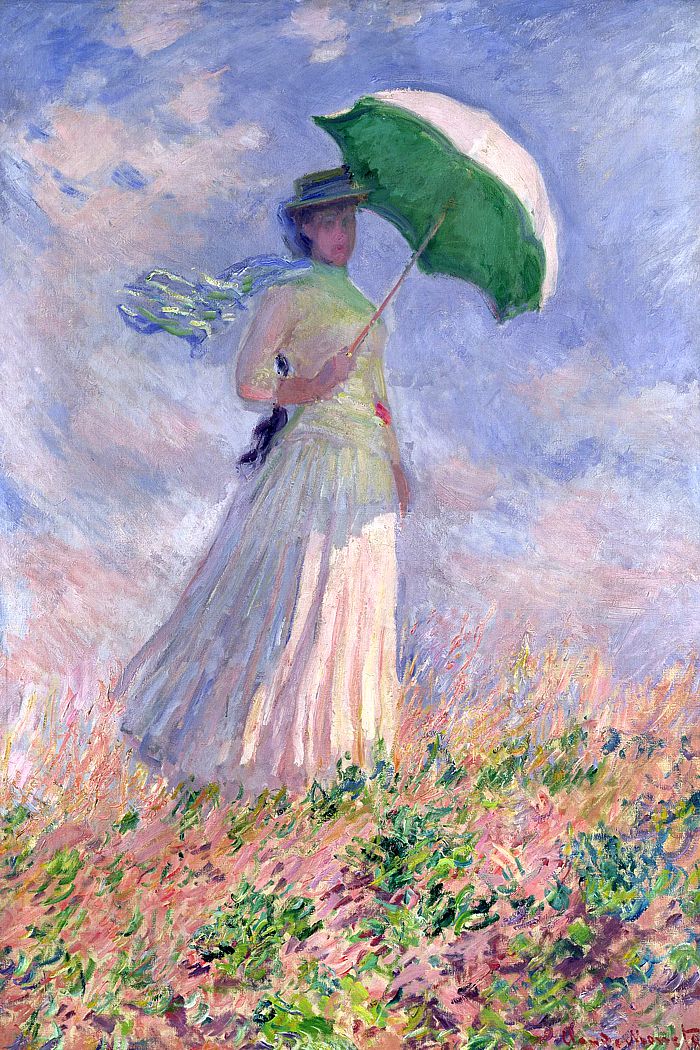
Woman with a Parasol Turned to the Right, 1886. Musée d'Orsay, Paris.
The Faceless Woman
The model was no longer Camille. She was Suzanne Hoschedé, Alice's daughter, who lived in the house at Giverny and was then about twenty-two years old. Monet placed her on the hill, filled her with light, and erased her face. There are no eyes, no mouth, no expression. There is a pale oval, barely suggested, beneath the shadow of the parasol.
It is hard not to see a decision in this. In 1875, Monet had painted a family portrait, intimate, almost spontaneous. By 1886, the figure had become something else: a place where the sun bounces, shifts, and turns into color. A surface, just as a tree, a rock, or a cloud is. For the Impressionist painter, the identity of the person mattered less and less. What mattered was what the light did to her.
And yet, by not giving her a face, Monet did something strange: he gave her mystery. We no longer know who she is. Nor do we know what she is looking at, whether a point on the path, a stormy thought, or the memory of a happy moment. The woman of 1886 is every woman who ever stopped on a hill to look at something that is no longer there.
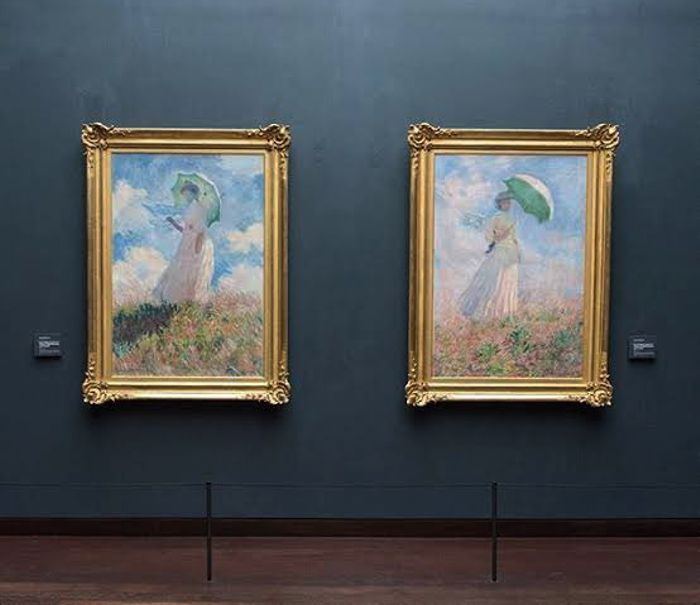
Woman with a Parasol Turned to the Right and Woman with a Parasol Turned to the Left. Musée d'Orsay, Paris.
What No One Knows for Certain
Why did Monet return to that hill? He never explained it. There is no letter, no note, no confession linking the canvases of 1886 to Camille's death. What does exist is the connection that many critics and visitors have felt when seeing them: one scene repeating another, a faceless body where there was once a face, and between them, an absence.
Perhaps it was only a painter's challenge, an experiment in how to paint the human figure outdoors. Perhaps it was something more. And perhaps painting her again was his way of asking forgiveness: no longer with the gaze that analyzes, but with the one that remembers.
What is certain is that some griefs do not fit into a single farewell. And some guilts can only be held by light. Camille remained where Monet wanted time to find her: in the air, neither present nor absent, between sky and earth.
Only wind. Only light.
THE WORKS
Woman with a Parasol, Claude Monet, France, 1875, National Gallery of Art, Washington, D.C.
Woman with a