

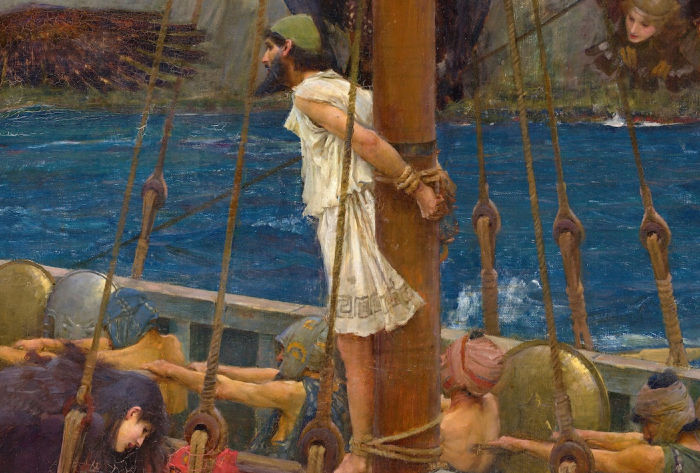
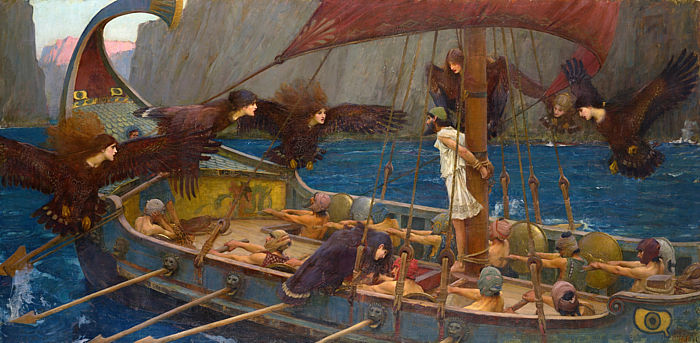
Some scenes from Greek mythology seem to have been made to speak about something that keeps happening thousands of years later. Ulysses facing the sirens is one of them. John William Waterhouse painted it in 1891, at one of the most interesting moments of his career, and the result is a strange, unsettling image: a man tied to the mast of his ship while creatures with female faces, bird bodies and enormous claws surround him.
The sailors row without looking back, their ears sealed with wax, and in the middle of it all Ulysses does something that seems absurd: he has had himself tied up on purpose, just so he can listen.
The painting now belongs to the collection of the National Gallery of Victoria in Melbourne and measures just over a metre in height by two metres wide. It was acquired directly from the artist in 1891, the same year it was shown at the Royal Academy in London. But to really understand the work, you have to go much further back, to ancient Greek tradition and to an episode from the Odyssey that, even today, remains one of the finest metaphors we have for self-control.
Sirens that never had a fish tail
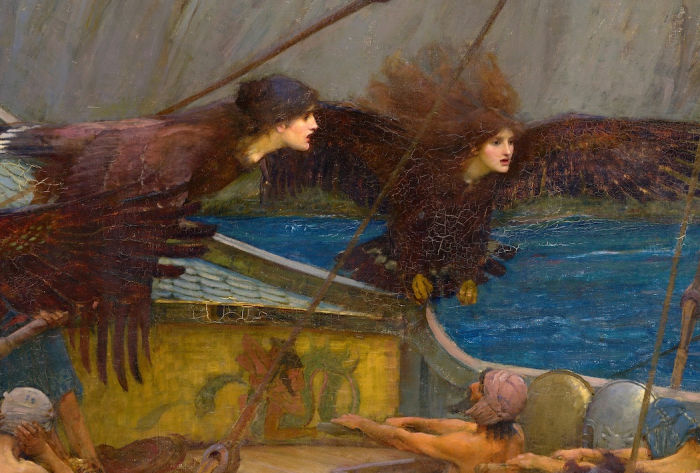
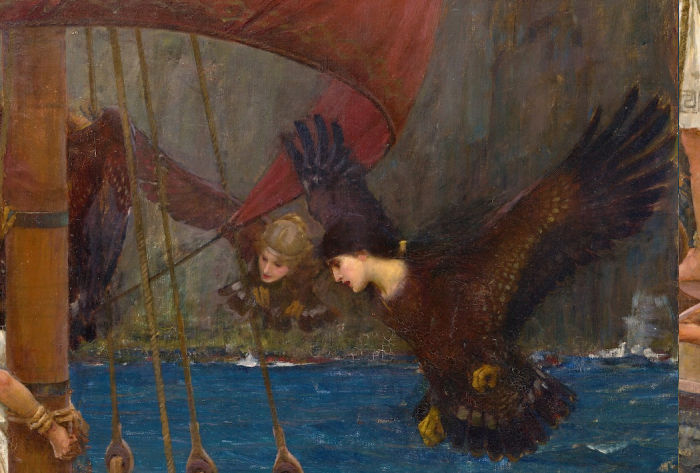
Our modern image of a siren, a beautiful woman with a fish tail, has nothing to do with the creatures that appear in this episode. In ancient Greek tradition, sirens were hybrid beings: women with bird-like features, shown with wings, talons or claws, and in many cases a bird's body. The British Museum holds examples of this iconography, including Hellenistic-period figures with a woman's head and torso and a bird's body, wings and feet.
This matters for understanding Waterhouse's choice. Homer never physically describes the sirens in the Odyssey: what he describes is their voice and the effect it has on whoever hears it. That's why the painter had to turn to ancient visual tradition to decide how to depict them, and the National Gallery of Victoria notes that he drew on a depiction of the episode found on an ancient Greek vase held at the British Museum.
The choice surprised Victorian audiences, who were used to a far more romantic, sensual image of sirens. Waterhouse deliberately brought back an unsettling look, close to ancient Greek iconography, so much so that some critics of the time complained his creatures looked more like harpies or birds of prey. But that is precisely where part of the painting's power lies: it doesn't depict a temptation that is simply beautiful, but one that, beneath its appeal, holds something monstrous.
The pact with Circe and a very particular trap
The scene comes from Book XII of the Odyssey. Before reaching the sirens, Ulysses receives a warning from Circe: whoever listens to their song will never return home. The sirens live in a meadow, and around them lie the remains of the men who have already given in to their voice. The solution seems simple enough, plug your ears with wax and keep rowing, but Ulysses wants to listen. He doesn't want to avoid the temptation entirely: he wants to know it.
Circe then offers him an extraordinary solution. His men can plug their ears while he stays tied to the mast, so he can hear the song without being able to throw himself into the sea. There's one decisive condition: if he later begs to be freed, his men must tie him even tighter. Ulysses agrees, and when they reach the sirens' waters, his men carry out exactly what was agreed.
Then the song begins, and Ulysses falls into the trap. The sirens call him by name and promise him something far more sophisticated than simple pleasure: they offer him knowledge. They claim to know everything the Greeks and Trojans suffered during the war, and to know everything that happens on earth. That's why Ulysses wanted to listen in the first place. It isn't mere curiosity: the sirens are offering exactly what defines the hero, knowing more, and that is precisely what makes them dangerous.
The perfect temptation for a hero who isn't the strongest
Ulysses is not the strongest hero in the Odyssey. His main asset is something else: intelligence, calculation, cunning. That's why the sirens' temptation is built in a particularly cruel way: they don't offer Ulysses something he holds in contempt, they offer him something he wants. The danger isn't only the pleasure itself, but the possibility of gaining extraordinary knowledge without seemingly paying any price at all.
But the price is hidden. To know, you have to get close. To listen, you have to expose yourself. And to expose yourself, all it takes is for judgment to stop working for a few moments. When Ulysses hears the song, he starts demanding to be set free. His companions, who cannot hear the sirens' voices, keep rowing and follow the original order: instead of untying him, they bind him even tighter. Only once they are out of range of the song do they remove the wax from their ears and free the hero. Ulysses survives because the Ulysses who existed before the temptation made a decision on behalf of the Ulysses who would be under its spell.
The mast as a symbol
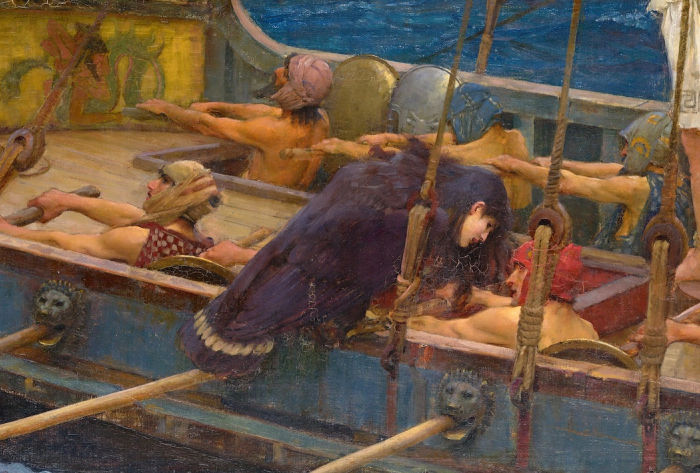
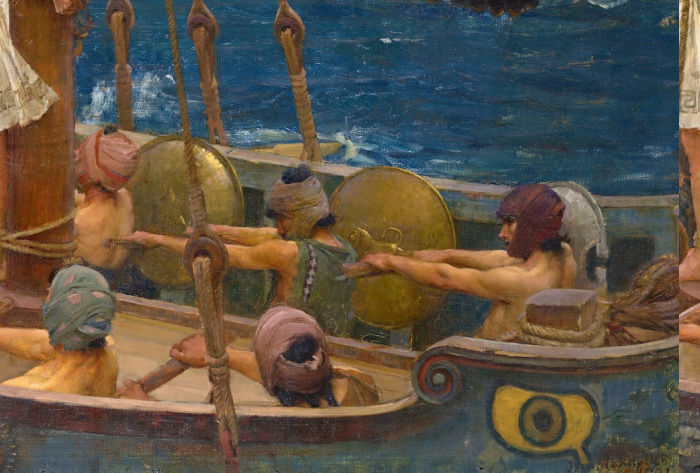
In Waterhouse's painting, the mast becomes practically the axis of the entire scene. Ulysses is at the centre, physically trapped, while the sirens move around him. The ship keeps moving thanks to men who take no part in the experience: their ears are sealed, and they represent, in a way, the practical side of the plan, simply pressing on. Ulysses, on the other hand, wants to look and listen. He is completely exposed.
The rope stands for a self-imposed limit. It isn't a prison forced on him by someone else, but a restriction he chose himself before finding himself in danger, and that changes the meaning of the scene entirely. Ulysses's strength doesn't lie in being able to resist everything. It lies in recognising what could defeat him.
There's also an important difference between Homer's account and the painting. In the Odyssey, the sirens' power is fundamentally in their voice. Waterhouse can't paint a song, so he has to turn a sound-based phenomenon into an image, and he does it by turning the song into physical presence. His sirens don't wait calmly on a rock for sailors to approach; in Waterhouse's composition, they seem to hurl themselves at the ship, their wings, bodies and claws invading the space around Ulysses. This choice was in fact one of the points that drew criticism when the work was exhibited in 1891: some commentators felt the creatures were too aggressive for a scene built around vocal seduction, while others defended Waterhouse's artistic freedom and his use of models drawn from ancient Greek art.
Ulysses's pact and the idea of precommitment
Centuries after Homer, this scene found a second life in modern thought. Philosopher and social scientist Jon Elster used the episode to develop his concept of precommitment, or self-binding. His work Ulysses and the Sirens: Studies in Rationality and Irrationality, originally published in 1979, turned the story into a classic example of how a person can voluntarily limit their present options in order to protect a future decision.
The idea is simple, and at the same time deeply uncomfortable. Sometimes we know what we want to do today, but we also know that in certain future circumstances we might want to do something else entirely. So we can use our current power to decide in order to stop that future version of ourselves from changing the plan. Ulysses does exactly that: his decision isn't simply "I won't listen to the sirens." It's something far more sophisticated, "I want to listen to them, but I know that once I do, I might no longer want to keep going." That's why he deliberately strips himself of the ability to choose. The rope doesn't stand for a lack of freedom, it stands for an extreme way of using freedom before losing control of it.
This is where the story's most fascinating paradox appears. Is Ulysses freer because he manages to hear the song, or is he freer because he willingly accepts that he won't be able to obey his own orders once the song begins? We tend to associate freedom with always having every option open, and Ulysses does exactly the opposite: he willingly gives up one possibility in order to preserve another. He could ask to be set free, but he has already decided in advance that such a request will carry no weight. His future self loses power because his present self planned for that loss ahead of time.
An image that keeps speaking
Waterhouse painted a story more than two thousand years old and, without necessarily setting out to do so in today's terms, ended up creating an image that can be read as a reflection on desire, knowledge, will and the limits of self-control. The sirens stand for what draws us in precisely because we know it can hurt us. The song stands for what manages to break through our defences. The ropes stand for a decision made before the critical moment arrives. And the ship stands for something even simpler: moving forward.
Maybe that's why Ulysses still feels so close to us. He doesn't defeat the sirens. He doesn't make them disappear. He doesn't prove that his will is unbreakable. He does something far smarter: he recognises that he can lose, and before the moment of losing arrives, he decides what he will do with himself. Waterhouse left him suspended in that instant, tied to the mast, surrounded by what he longs to hear, while the ship keeps moving forward. The hero isn't proving that he can't be seduced. He's proving that even someone who knows his own weaknesses can still find a way to keep going.
THE ARTWORK
Ulysses and the Sirens
1891
John William Waterhouse
Oil on canvas
Size 100 cm × 201.7 cm
Location National Gallery of Victoria, Melbourne, Australia