

The Greeks had a warning for anyone approaching a solitary spring: if a nymph sees you, or if you see her, you never come back the same. Some returned unhinged. Others never returned. In Brescia, a white marble freezes that exact instant: a nude young woman about to step into a stream, and someone watching her from behind without her noticing.
The Mistresses of the Water
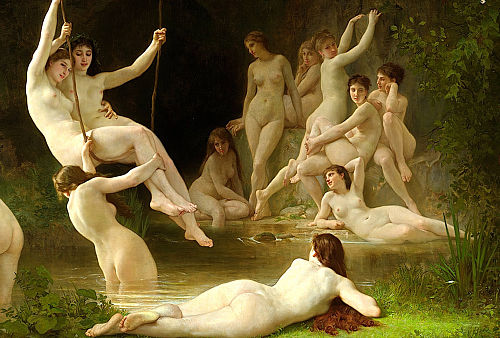
Before plumbing, water was a mystery with a will of its own. It gushed from the rock for no apparent reason, healed wounds, saved an entire village from thirst or, one fine day, dried up without warning. No one knew where it came from or why it left. The Greeks gave a face to that force: the naiads, nymphs of springs, streams, fountains and lakes. Their name is linked to the Greek verb meaning "to flow," and it could not be more fitting.
They were not goddesses of great temples or majestic altars, but something closer and more unsettling: local presences. Every spring had its own, just as every village has a corner where no one stays alone at night. In the Homeric tradition they are daughters of Zeus; other versions make them kin to the river gods. They were young, beautiful, lovers of dance and of the woods, and they belonged to the retinue of gods such as Artemis or Dionysus. Travelers left offerings beside the water to win their favor, and the Romans, ever practical, raised nymphaea for them: monumental fountains consecrated to the nymphs that adorned entire cities.
But there was a belief that raised goosebumps. Whoever saw a nymph could become "seized" by her. The Greeks even had a word for that state: nympholeptos, the one taken by the nymphs. It described someone who had exchanged a glance he should not have, and who was never the same again, as if a part of him had stayed forever beside the spring. With the water nymphs, the danger was not in bothering them. It was simply in crossing their path.
The Young Man Who Went to Fetch Water
The most famous story begins with a domestic chore. The Argo, the ship of Jason and his heroes, has stopped on the coast of Mysia. Evening is falling, the men light the fire, prepare beds of leaves, and someone must bring water for dinner. Hylas volunteers, the young companion of Heracles, the one who followed him everywhere and carried his weapons. He takes a bronze jar and walks into the forest, never imagining it will be the last time anyone sees him.
He finds a spring of clear water, surrounded by reeds and wildflowers. It was, unknown to him, the territory of the nymphs. According to Apollonius of Rhodes, the nymphs of the place were getting ready to dance. The moon lit the boy's face as he leaned over the spring to fill his jar, and one of them saw him. Her heart was stirred. She took him by the arm, drew him toward her and pulled him into the current.
Only a single cry was heard. Polyphemus, one of the Argonauts, heard it and ran to warn Heracles. The hero, the strongest of them all, the one who had defeated monsters and beasts, ranged through the forest beside himself, calling the boy aloud. No one answered. While they searched among the trees, the Argo sailed without them. The greatest feat of Heracles on that coast was, quite simply, failing to find a boy.
Notice the logic of the myth: Hylas did nothing wrong. He desecrated no sacred place and offended no one. He only leaned over the water. And the water, which had always belonged to others, kept him. According to the same tradition, the people of that region went on calling his name in an annual ceremony, as if he could still answer from the depths of the spring.
The One Who Fled and the One Who Would Not Let Go
Not every story of nymphs and water ends the same way. Arethusa belonged to the retinue of Artemis. One day, worn out after the hunt, she came upon a river of transparent water and stepped in to bathe. Soon she felt a strange murmur beneath the surface, something stirring in the current: it was Alpheus, the river god, who desired her. Arethusa climbed out of the water and ran. She ran until her strength failed and begged Artemis for help, who wrapped her in a cloud. But the god kept lingering around the cloud, and the terrified nymph dissolved into sweat, and from that sweat a stream was born. Artemis split open the earth and the water slid through underground channels, beneath the sea, until it resurfaced on the island of Ortygia, across from Syracuse, turned into a spring. Alpheus, however, followed her, and his waters mingled with hers.
Salmacis, by contrast, was a nymph who cared nothing for hunting or racing. She spent her days combing her hair and gazing into her pool, like someone conversing with her own reflection. When she saw the young Hermaphroditus bathing, she threw herself on him, clasped him tightly and begged the gods that they never be parted. She was heard: the two bodies fused into one, and the pool was marked forever by that desire.
Even Narcissus, the young man who died gazing at his reflection in a pool, was the son of a naiad, Liriope, and of the river god Cephissus. Water, in these tales, is mirror, trap, refuge and destiny all at once.
One nymph vanishes, another becomes water, another fuses with the one she loved. In the world of the nymphs, entering the water is never an innocent act.
What the Marble Says Without Saying It
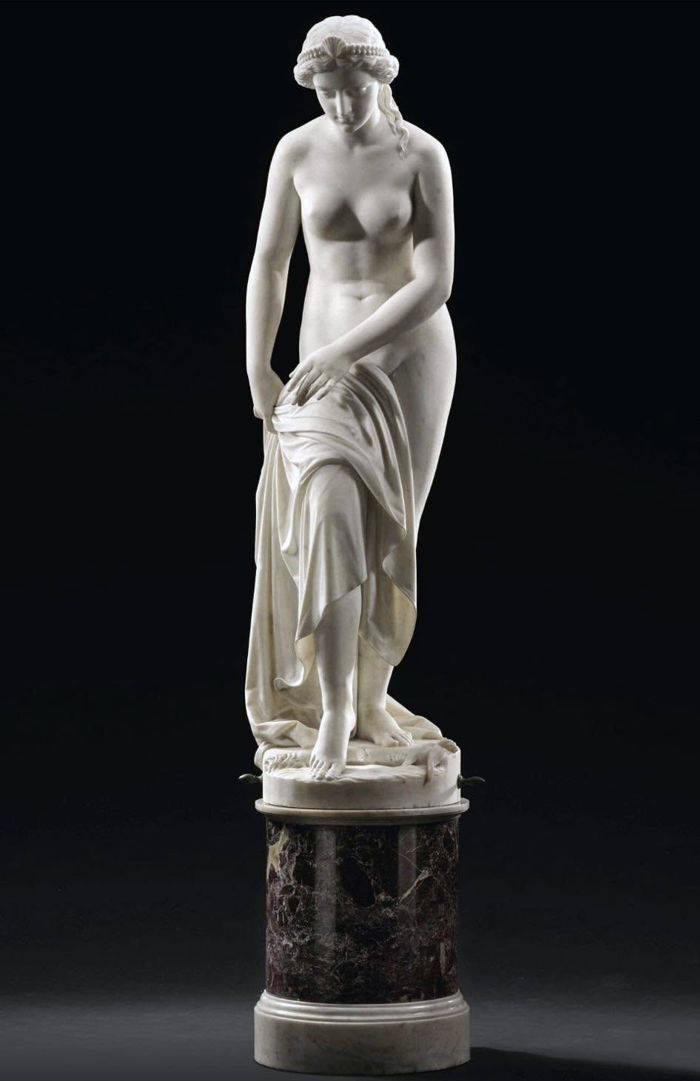
Lombardi's sculpture does not illustrate any of these stories in particular. Its title, Naiad or Nymph, is deliberately open. And perhaps that is its strength: it does not tell the myth, it tells the second before any of them, the instant when nothing has happened yet and everything can happen.
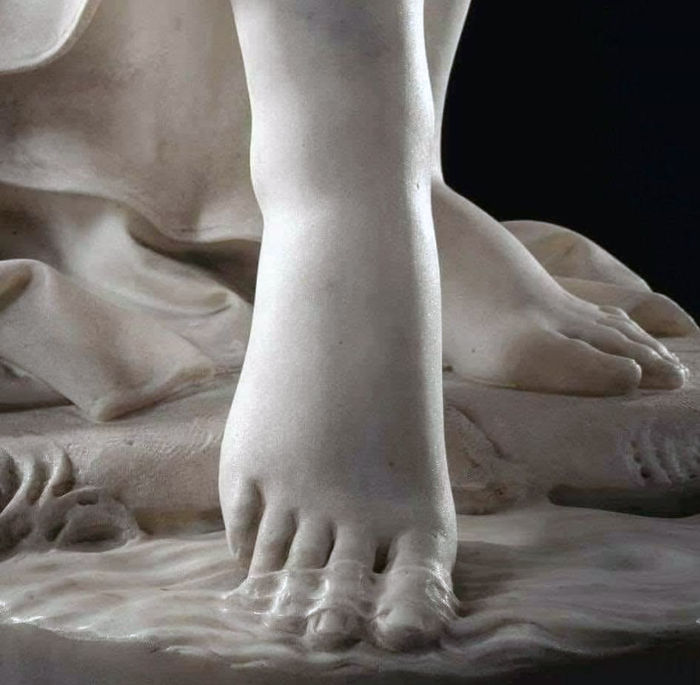
The young woman stands on the threshold. As she feels the cold water on her toes, she hesitates. That threshold is the exact point where, in all the earlier stories, something changes: someone disappears, someone is transformed, someone is joined to another forever. Water, in myth, is a passage to another state, and the sculptor chose to stop his figure just before she crosses it. That hesitation is the most human thing about the figure, and also the most unsettling, because we know what water tends to do with those who enter it.
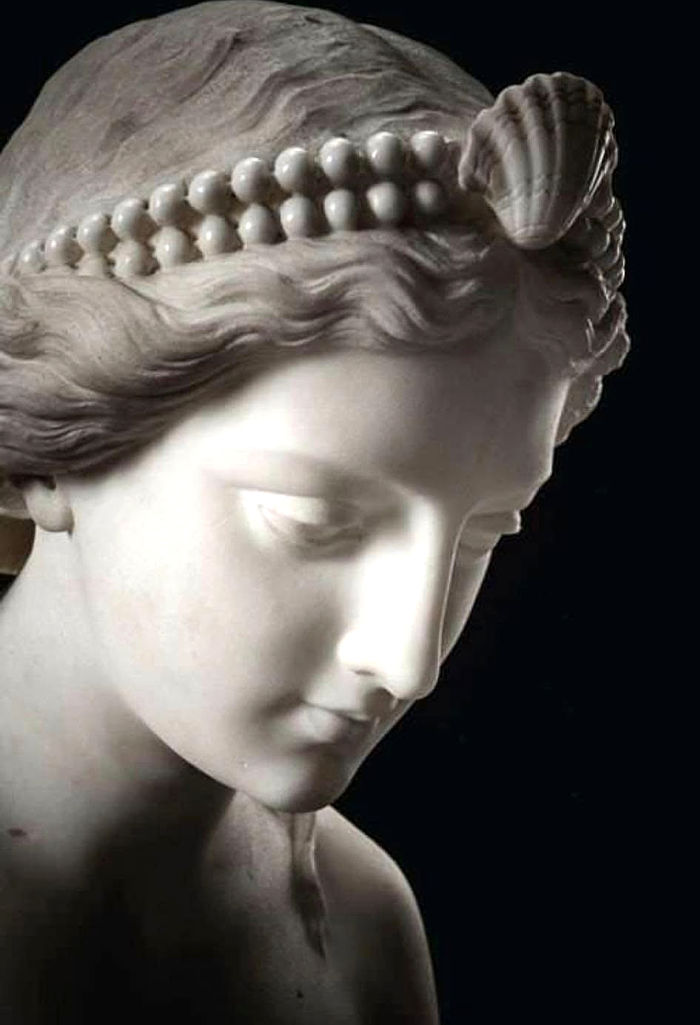
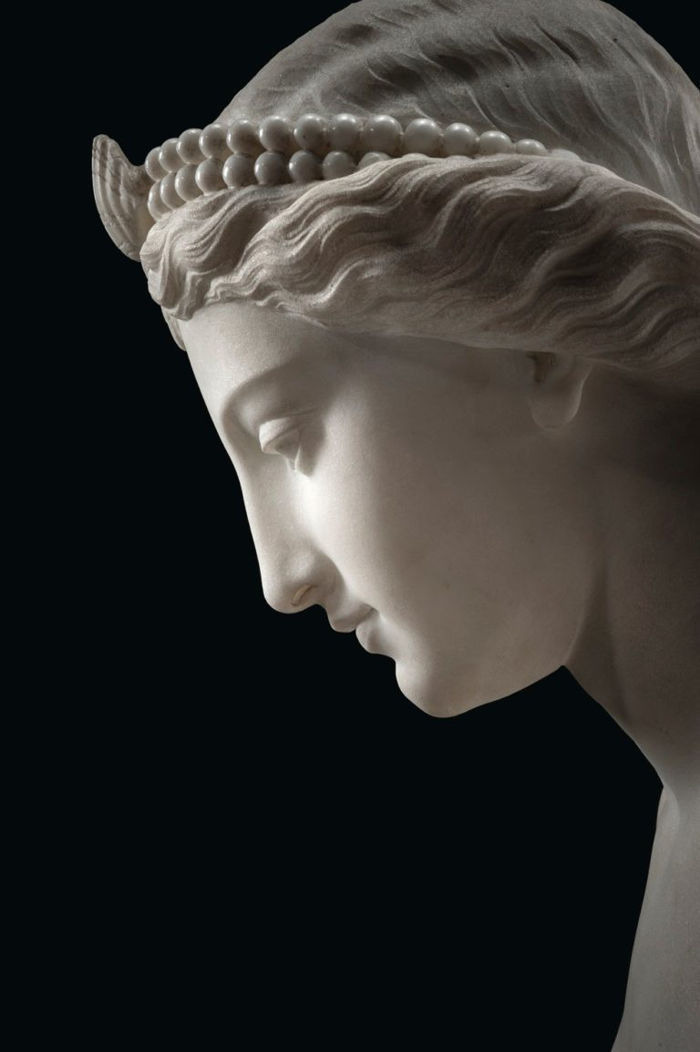
The diadem is the second code. It is carved with pearls and, at its center, a shell. The shell belongs to the world of Aphrodite, born from the sea foam, and pearls form inside shells: jewels made by water. On this young woman they work as credentials. She is no ordinary bather cooling off on a summer afternoon. She is someone of the water, someone entering her own territory.
The left hand, placed in front of the body, is an inherited gesture. It is the pose of the Venus Pudica, the formula ancient sculptors used to portray Aphrodite surprised in her nudity. But there is a subtlety: the nymph does not look at us. She looks at the water. Her modesty is addressed to no one, and so the viewer is left in an uncomfortable position, that of someone who watches without being seen.
The cloth she is slipping off completes the tale. It is not quite a dress nor quite a veil: it is the last thing separating her from the water, and it is about to fall. Everything in the figure is halfway between two states, between dressing and undressing, between the bank and the current, between a young woman and a nymph.
The sculpture invites us to walk around it. It is appreciated "in the round": one circles it until reaching her back, her wavy braids, the cloth sliding away. It is the position of someone leaning over a spring that does not belong to them. And if the myth is right, looking at a nymph was never an act without consequences, even if here the only consequence is lingering a little longer than planned in front of the marble.
The Work and the Cold of the Water
Giovanni Battista Lombardi, a Brescian sculptor of Romantic sensibility, carved this figure in 1868, in white marble on a base of red veined marble. His Roman training shows in the idealized face, in the confident handling of the female anatomy and in the folds of the drapery, which recall classical models. But there is something softer here than in strict Neoclassicism: the hesitation, the shy gesture, the emotion of a human moment. Classical simplicity and Romantic feeling in a single body.
The finely carved features, the hair worked strand by strand and the braids falling down her back reveal a sculptor who mastered his craft down to the last detail. Everything is designed so that the figure can be viewed from any side without losing harmony, and the rear view is, perhaps, the most elegant of all.
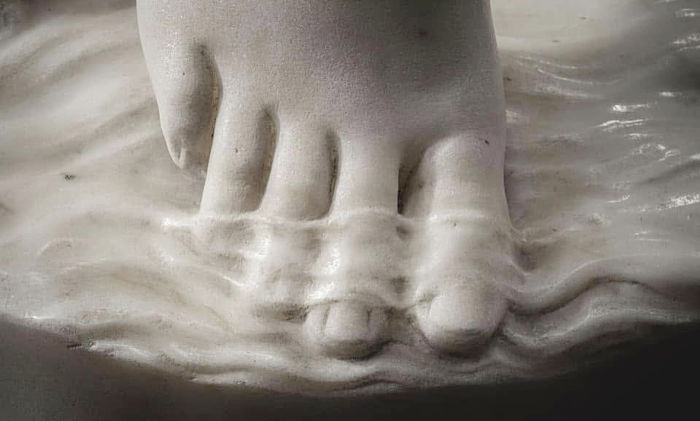
And then there is the detail that tells it all: the water running over her toes. Carved in hard, cold stone, it seems liquid, and you can almost feel its touch. That delicacy would have echoed the experience of those who visited the baths of the Palazzo Facchi, and it makes plain the sculptor's mastery in bringing marble to life. It takes great talent to make stone look wet, and even more to make it look cold.
What Lombardi achieved is to make the marble turn cold. To make the viewer, without knowing which nymph she is or which spring she comes from, grasp the essential: she stands before a threshold, and on the other side of the water, things change. The young woman gazes at the current, hesitates... and the myth, as always, waits.
THE WORK
Naiad or Nymph
Giovanni Battista Lombardi
White marble on a base of red veined marble
1868. Palazzo Facchi, Brescia.