

For centuries, millions of people have looked at the same scene and reached an almost inevitable conclusion: the woman portrayed by Jan van Eyck appears to be about to give birth. Her rounded belly, the hand gathering her dress, and the solemnity of the encounter seem to announce the arrival of new life.
However, there is one detail that completely transforms the way we look at this work: the appearance of pregnancy does not necessarily mean that the woman was expecting a child. And that is not all. Some art historians have proposed a far more unsettling interpretation: perhaps this painting does not celebrate a wedding, but rather commemorates the death of a wife. What appears to be a domestic scene could conceal, beneath its magnificent fabrics and everyday objects, a story of love, wealth, fertility, and loss.
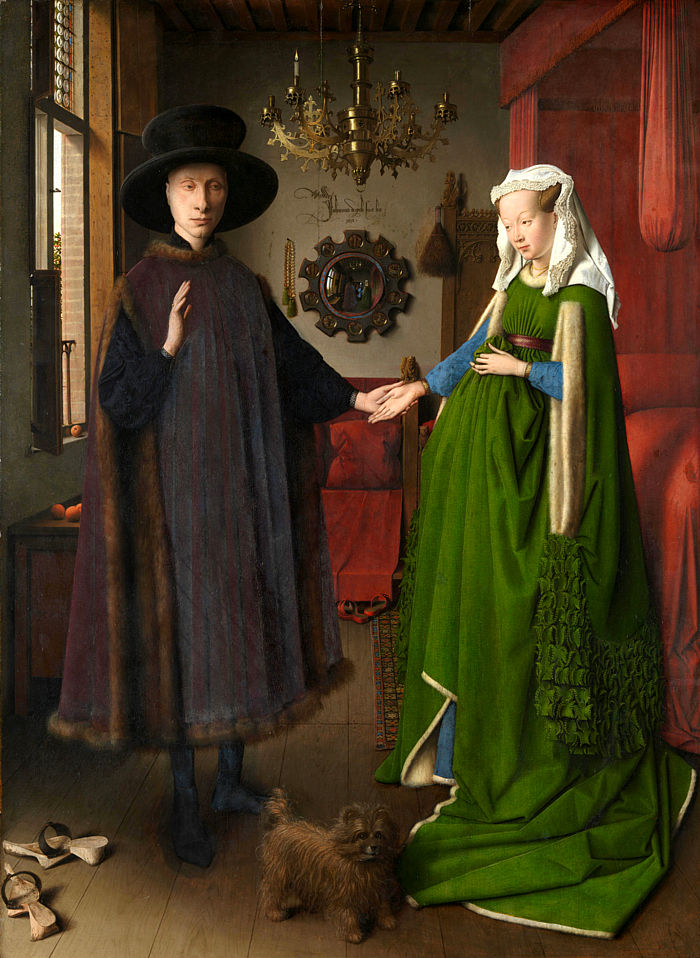
Painted in 1434, *The Arnolfini Portrait* is one of the most celebrated works by Jan van Eyck, a master of fifteenth-century Flemish painting. Now housed at the National Gallery in London, this small oil painting on panel, measuring just 82 centimeters high by 60 centimeters wide, demonstrates how an artist can transform a room into a universe of meanings. Every object seems to have been placed with extraordinary precision; every reflection, every fold, and every glimmer of light contributes to a scene that is as realistic as it is enigmatic.
The man and woman stand in an elegantly furnished room. He wears a heavy, dark garment and raises one hand as if greeting someone who has just entered. She wears a green dress with wide sleeves, lined with fur, whose abundant fabric gathers around her body. There is a solemn space between them. Behind them, a wooden bed with red curtains, a convex mirror, and a bronze chandelier complete the setting. On the floor, a small dog gazes toward the viewer.
The scene seems simple enough. Yet as the painting has been studied more closely, questions have multiplied. Are we looking at a married couple? Is some kind of ceremony taking place? What does the inscription Jan van Eyck left on the wall mean? And why is one candle burning while another appears extinguished in the chandelier? The most intriguing answer is that, although we know many details about the painting, its exact meaning remains a matter of debate.
The Dress That Misled Generations
The first key to understanding this work is to abandon our contemporary perspective and travel back to fifteenth-century Europe. Today, when we see a woman with a prominent belly and one hand resting on it, we immediately interpret the gesture as a sign of pregnancy. But clothing conventions and artistic representations were very different in Van Eyck's time.
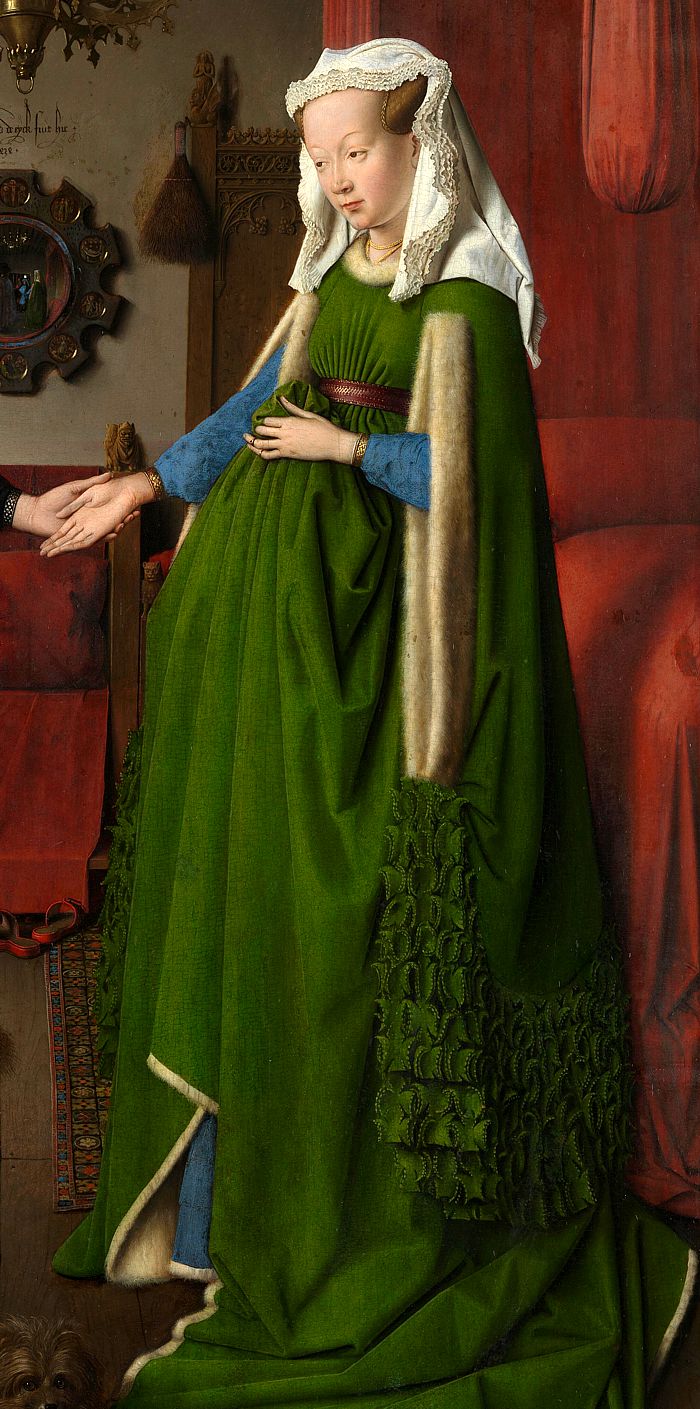
The woman portrayed, traditionally identified as Giovanna Cenami, wears an extraordinarily voluminous dress. Its deep green color, fur lining, and sheer quantity of fabric indicate a privileged economic position. In that society, clothing was not merely a necessity: it was a public display of wealth. Fine textiles, furs, and garments made from enormous quantities of material could command considerable prices and become visible symbols of prestige.
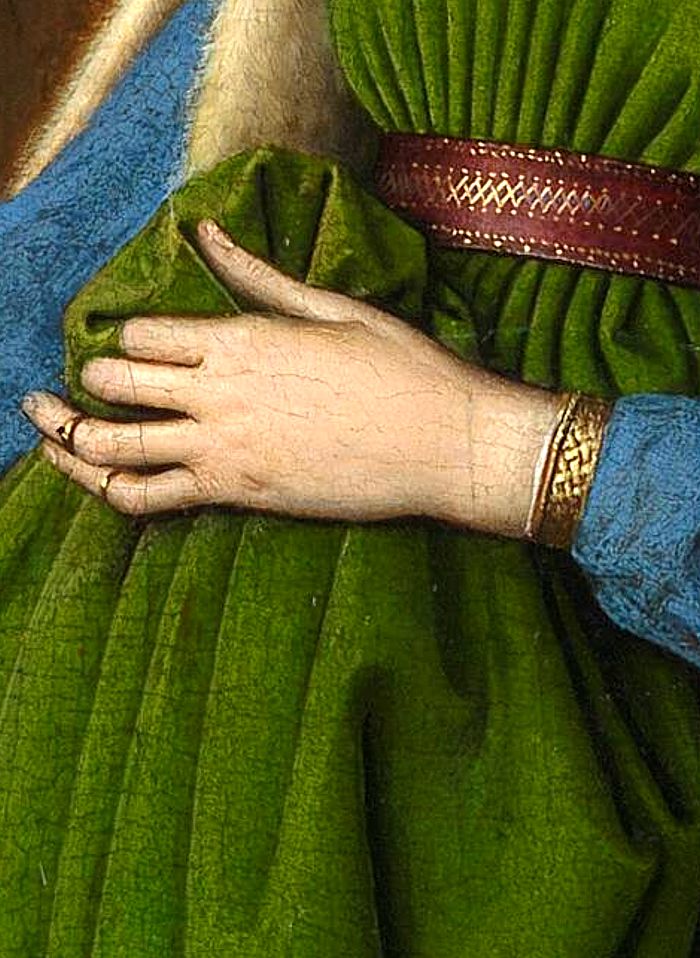
Giovanna's silhouette reflects this fashion. The dress is gathered at the front, forming a large accumulation of folds over her abdomen. She holds part of the fabric in one hand, a gesture that allows us to appreciate the richness of the material and also reflects the way such voluminous garments were worn. Her posture, moreover, corresponds to certain aesthetic conventions of the period, which favored pronounced curves and figures with arched backs.
For this reason, the most widely accepted explanation today is that the woman is not literally depicted as pregnant. The effect results from the combination of clothing, gesture, and the visual ideals of the time. As the National Gallery explains, her fur-lined dress creates this impression, while the fashions of the period offer a much more convincing explanation than an actual pregnancy.
But resolving this first mystery does not mean that motherhood disappears from the painting. On the contrary, Van Eyck may have been alluding to fertility and to the expectations placed upon married women without depicting an actual pregnancy.
In the fifteenth century, motherhood played a fundamental role in the continuity of families and, particularly among privileged groups, in the transmission of property, family names, and wealth. For an affluent merchant family, securing descendants could be an intimate, social, and economic concern all at once. The female body became associated, in a way that is difficult for us to imagine today, with the responsibility of ensuring the future of the family lineage.
Thus, Giovanna's belly can acquire a symbolic meaning without necessarily announcing an imminent birth. The image might express the expectation of motherhood, a family aspiration, or the ideal of prosperity associated with married life. The painting offers no definitive answer, but it forces us to distinguish between what we see and what we have grown accustomed to believing we see.
A Room Full of Clues
If we shift our attention away from the dress and begin to explore the rest of the composition, we discover that Van Eyck has transformed everyday objects into silent protagonists of the scene.
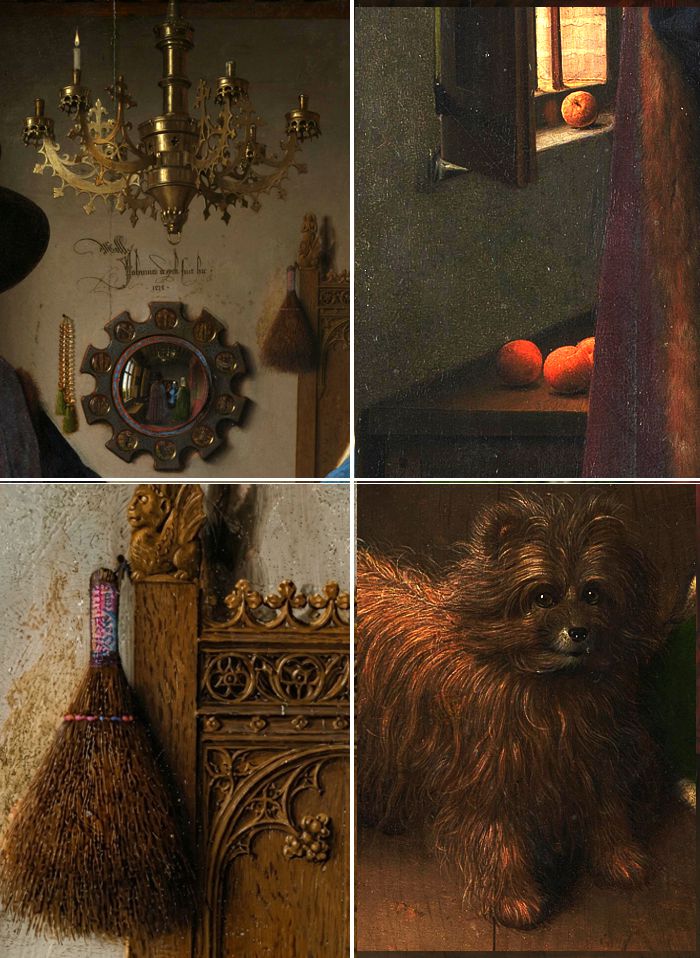
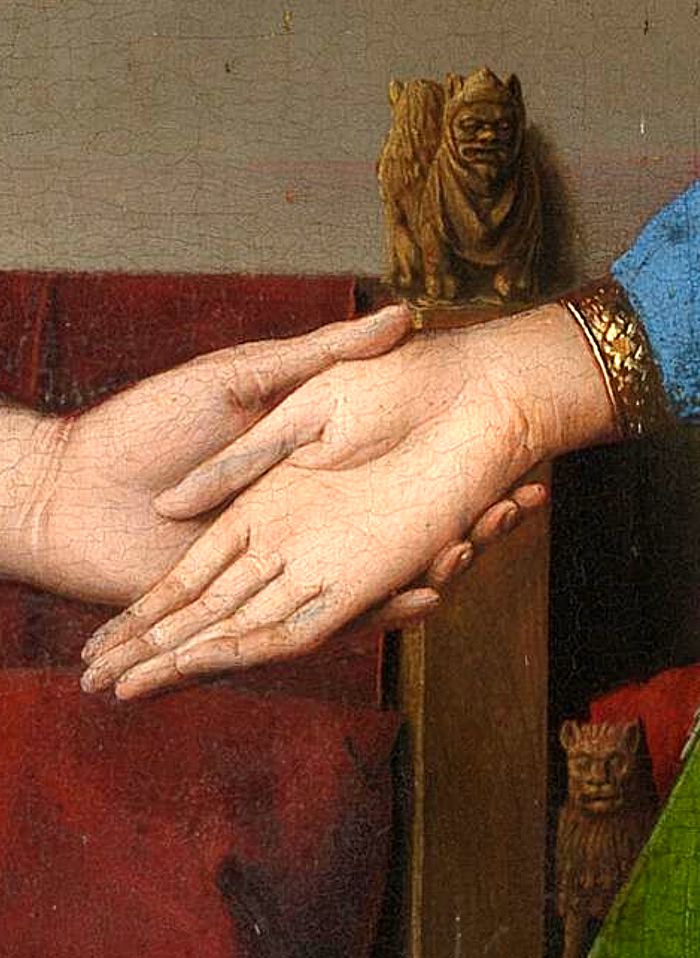
Consider, for example, the back of the chair beside the bed. There, we find a female figure associated with a dragon, commonly identified as Saint Margaret, the patron saint of pregnant women and of those seeking protection during childbirth. Her presence becomes especially significant when viewed alongside Giovanna's silhouette. Is she a reference to the motherhood expected of Giovanna? A symbol of protection for a woman who wished to have children? This is a possible interpretation, although we cannot be certain that it was Van Eyck's sole intention.
We also find fruit on the piece of furniture beneath the window and on the windowsill. Oranges were expensive commodities in northern Europe and could therefore serve as a display of wealth. Their presence has also prompted interpretations relating to fertility, abundance, and paradise. Nevertheless, we should remember that an object could serve several purposes simultaneously: it could be a luxury item, enhance the visual richness of the scene, and suggest symbolic associations without our being able to determine which meaning the artist intended to emphasize.
The small dog standing at the couple's feet is another of the painting's most frequently discussed details. It has traditionally been interpreted as an allegory of fidelity, a quality closely associated with marriage. The image seems to fit this reading perfectly: the animal occupies the space between the protagonists and becomes a discreet presence accompanying their encounter.
However, interpreting these elements is not as straightforward as it might seem. Art historians have pointed out that not every object in the painting should necessarily be understood as part of a deliberately organized symbolic code. Some may have been included for decorative reasons, because of their material value, or because the artist wanted to portray the interior of an affluent home with extraordinary precision.
And here we encounter one of Van Eyck's greatest strengths: his ability to make everyday life seem to contain something extraordinary.
The bronze chandelier, for example, looks almost real. Light reflects off the metal, revealing its curves with astonishing precision. The prayer beads hanging beside the mirror catch tiny glimmers of light. The fabrics seem to possess weight, texture, and even temperature. The artist does not merely paint objects; he reproduces the way light transforms them and connects them to one another.
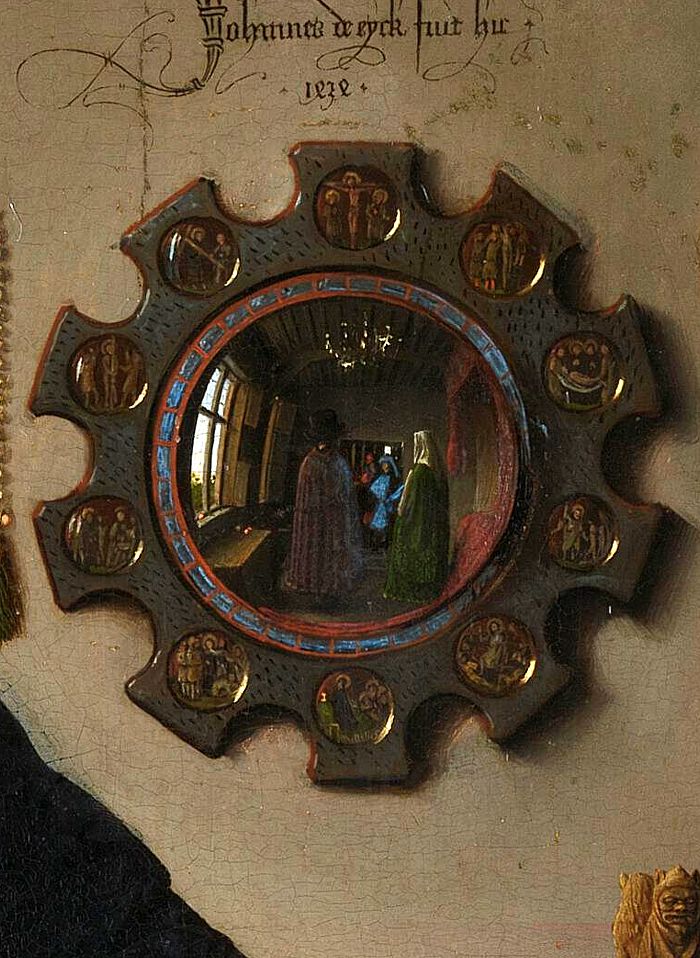
At the center of the wall appears an inscription in Latin: *Johannes de eyck fuit hic. 1434*. It means, "Jan van Eyck was here. 1434." The inscription stands out because of its position and solemn appearance. Rather than simply signing his work discreetly, the painter seems to be recording his presence in that room.
This inscription has fueled the idea that Van Eyck acted as a witness to an important event. For a long time, some scholars interpreted the painting as a kind of visual record of a marriage. However, this theory has been challenged, and the inscription alone does not prove that the artist was certifying a wedding ceremony. It can also be understood as an unusually elaborate assertion of authorship.
The painting, therefore, does more than show us two figures. It also reminds us that behind this scene stood an artist fully aware of his extraordinary ability to represent the visible world.
The Mirror That Changes the Entire Story
If any object can turn this room into an enigma, it is the small convex mirror hanging behind the couple. At first glance, it might seem like a decorative accessory. But when we look more closely, we discover that it reflects the room from a completely different perspective.
On its curved surface, we can see the backs of the two figures, the doorway opposite them, and two small figures who appear to be entering the room. One of them is dressed in red. Who are they? Visitors arriving at the house? Witnesses to a private scene? Could one of them be Van Eyck himself, accompanied by another person? The possibility that one of these figures represents the artist has proved particularly appealing to researchers, although their identities have not been established.
The mirror is surrounded by small scenes depicting episodes from the Passion of Christ. These images introduce a religious dimension into a space that otherwise appears entirely domestic. Everyday life and spirituality are thus brought together on the same surface.
Van Eyck's technical skill is extraordinary: he makes a tiny object expand the room's space while simultaneously raising new questions. The viewer ceases to be an outside observer. Thanks to the mirror, we seem to occupy the place of the people entering the scene.
And it is precisely this detail that makes the painting so unsettling. We do not know for certain what is happening, but we sense that something important is unfolding before our eyes.
A Marriage or the Memory of a Deceased Woman?
In 2003, art historian Margaret Koster proposed an interpretation that reopened the debate over the painting's meaning. Rather than viewing the portrait as a wedding taking place during the lifetime of both protagonists, she suggested that it might be a commemorative image dedicated to a woman who had died.
This hypothesis is unsettling because it changes the meaning of numerous details. What appeared to be a celebration of marital union could become a meditation on absence, death, and memory.
One of the most striking elements is the chandelier above the figures' heads. One candle is burning, while another is extinguished. The living flame might be interpreted as a reference to God's presence or the continuity of life, while the extinguished candle could suggest the death of one of the protagonists. According to Koster's interpretation, the contrast between the two would take on a particularly painful meaning if the woman had already died.
Nevertheless, interpretations of the candles remain disputed. An extinguished candle is not, in itself, proof of mourning, and the presence of a flame in a room illuminated by daylight may also reflect artistic choices or domestic conventions. The detail is suggestive, but it does not allow us to reach a definitive conclusion.
The funerary hypothesis also directs our attention toward the mirror. The small scenes from the Passion of Christ depict different moments of his suffering and death, followed by the hope of resurrection. Koster interpreted the arrangement of these images in relation to the two figures, proposing a reading in which life and death are reflected differently on each side of the composition.
This interpretation invites us to view the portrait from a darker perspective, although it is important to note that the arrangement of the scenes does not prove that the mirror was designed to convey a funerary message. The episodes of the Passion could also have served a devotional purpose within a marital portrait.
The dog takes on a different meaning under this hypothesis. If it traditionally represents marital fidelity, it might also evoke loyalty that survives the loss of a loved one. In medieval and Renaissance art, animals appear alongside human figures as symbols of virtues, emotional bonds, and remembrance. However, there is no universal rule allowing us to claim that every dog positioned at a couple's feet represents fidelity continuing beyond death.
The strength of Koster's theory, therefore, does not lie in having definitively solved the mystery, but in demonstrating that the scene allows for a different interpretation from the traditional one.
If the woman had died before the painting was created, the fullness of her dress could take on a particularly tragic dimension. The image of anticipated, suggested, or idealized motherhood would then confront the irreversible absence of the woman who might have made it possible. In an era when complications during pregnancy and childbirth posed serious risks to women, this possibility is historically understandable, although it does not prove that this was the fate of the woman portrayed.
We must also be cautious about her identity. Although the figures have traditionally been associated with Giovanni Arnolfini and Giovanna Cenami, the woman's exact identity and the interpretation of the event being depicted remain subjects of debate. The painting's date and the available documentary evidence have led scholars to reconsider some of the older theories about its connection to a marriage.
Koster's hypothesis is, ultimately, a significant art-historical interpretation, not an established fact. The painting contains no inscription confirming that it is a posthumous tribute, and the same elements can support other explanations. This uncertainty is part of its appeal.
A Work That Refuses to Reveal Its Secret
Perhaps the greatest mistake we can make when looking at *The Arnolfini Portrait* is to assume that a work studied for so long must have a single explanation capable of resolving all its mysteries. The history of art shows us that images change in meaning according to their context, the available documents, and the questions each generation brings to them.
For a long time, Giovanna's belly was considered proof of pregnancy. Today, we know that the fashion of the period explains much of this appearance, although her silhouette may also evoke the expectations of motherhood placed upon married women. The dog may symbolize fidelity, but not necessarily fidelity beyond death. The extinguished candle may suggest an absence, although it does not prove that anyone has died. And the mirror, despite its extraordinary ability to expand the scene, does not allow us to identify with certainty the people reflected in it.
What remains beyond doubt is Jan van Eyck's mastery. With a relatively small wooden panel, he created a space that seems to extend beyond its boundaries. Light enters through the window, glides across the objects, and transforms every surface into a visual experience. The artist makes viewers feel as though they are standing in a fifteenth-century room while simultaneously suspecting that they are not seeing the whole story.
Perhaps we are looking at a marital portrait intended to display a family's prosperity. Perhaps certain details express aspirations of fertility, devotion, and dynastic continuity. Or perhaps, as Margaret Koster suggested, the painting preserves the memory of a woman whose absence forever transformed the meaning of the scene.
We have no definitive answer. And perhaps that is precisely what keeps our fascination alive.
Because, after nearly six centuries, we continue to return to the same detail: a woman, a green dress, and a hand gathering the fabric over her belly. We think we recognize what we are seeing, until we discover that our first impression may be misleading. Then we look again at the candle, the mirror, the dog, and the small figure of Saint Margaret, and we realize that the painting contains far more questions than it seemed to raise at first.
That is Van Eyck's genius: he makes us believe we are looking at an everyday scene while inviting us to search, behind every fold and every reflection, for a story we may never fully uncover.