

In the light of a mysterious glow, two figures emerge from the shadows in an intricate embrace. A pale, radiant woman leans toward a young man with golden curls, their lips barely centimeters apart, in a frozen moment that seems both fragile and immortal. Around them, in a disquieting display, enigmatic figures watch, hide and reveal, holding symbols that look like warnings and prophecies, such as Folly and Time.
This is no ordinary romance. The work before us is a visual puzzle, a Renaissance riddle in which every character, every gesture and every detail carries a double meaning. And one of its most unsettling readings holds that this painting is not a love scene at all, but a medical record.
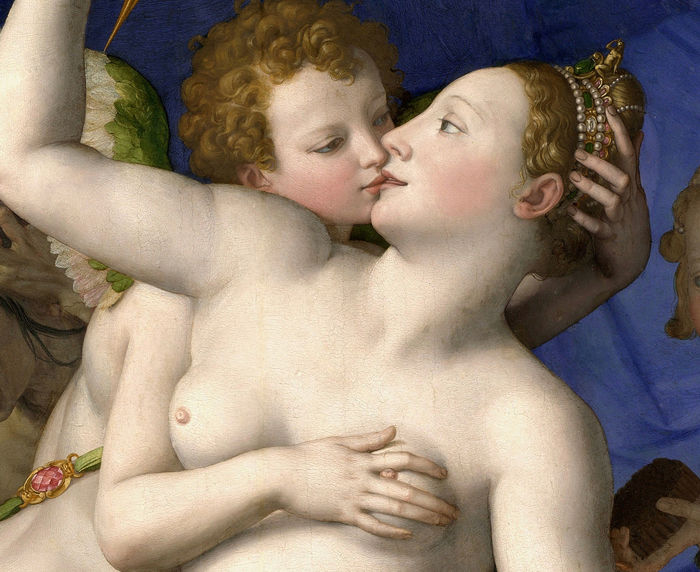
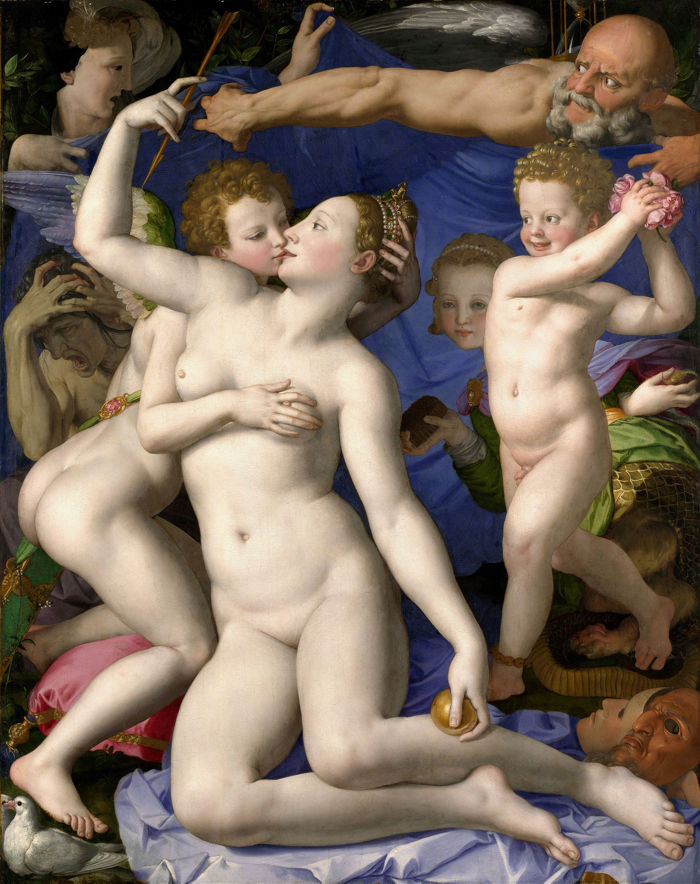
We are looking at "Venus, Cupid, Folly and Time", also known as the "Allegory of the Triumph of Venus", painted around 1545 by the Florentine master Agnolo Bronzino. It is one of the most captivating and complex creations of the Italian Renaissance. In this scene, which at first glance seems to depict a romantic attraction, Bronzino explores far more than ordinary human emotions. He presents an allegory of lust, deceit, vanity, and the devastating consequences of unrestrained love and desire.
This painting is a warning disguised as seduction, a reminder to the viewer that desire without restraint or morality can lead us to madness and destruction. The figures, caught in a chaotic dance, seem to reveal their darkest secrets in an atmosphere thick with mystery and symbolism.
Let us dive into the details of this painting and discover who these figures really are, what role each plays in this intricate scene, and what Bronzino is trying to tell us through them.
The Complexity of Bronzino's "Venus, Cupid, Folly and Time"
The painting presents Venus and Cupid as its central figures, in a composition that defies conventional morality. Venus, the goddess of love and beauty, is shown in all her sensual splendor, while her son Cupid answers her with a disturbing passion. Their bodies intertwine in an unsettling pose, a relationship that conveys both attraction and a warning about the dangers of limitless carnal love.
The choice of Venus and Cupid as protagonists carries a mythological background that adds depth. Venus represents love in all its forms, both divine and human. Cupid, her son, is the personification of impulsive love, often blind and overflowing. Their connection in this work seems to blur the line between love and lust, suggesting an unsettling message about the power of desire and its possible excesses.
Bronzino does not soften that tension: Venus and Cupid kiss despite being mother and son, and she takes an arrow from him while he caresses her. Venus also holds the golden apple, the one from the judgment of Paris, the object by which she is recognized. The goddess of love is disarming the very god of desire, while he toys with her crown. Everything in the scene revolves around the power of desire: who controls it, who falls into it, and what price they end up paying.
For sixteenth-century medicine, uncontrolled desire was not merely a moral failing. It was the gateway to venereal disease, a word that comes directly from the name of Venus.
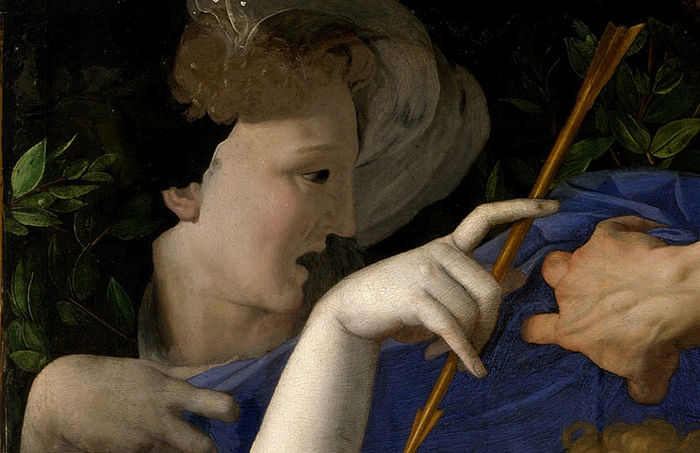
The Figure Tearing Out Her Hair
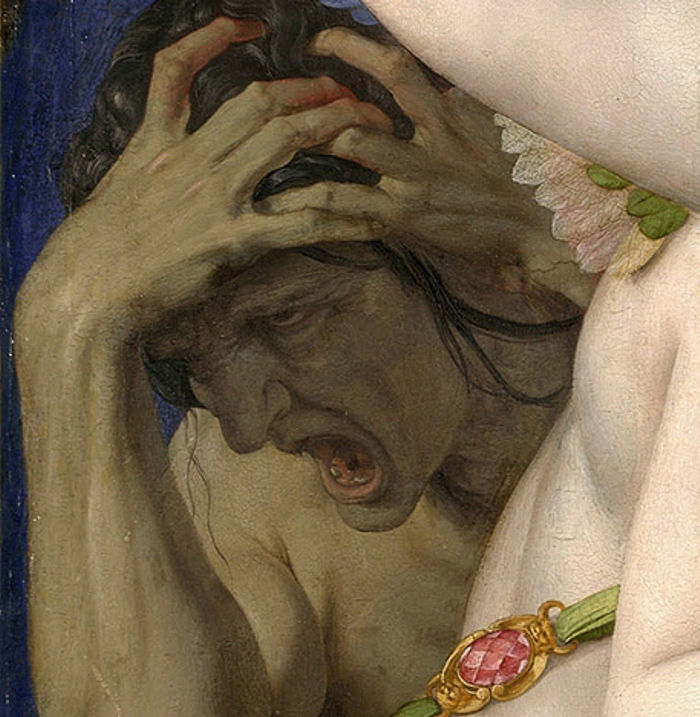
Behind Cupid appears a figure tearing out her hair in tufts. Her hands are clenched like claws and, in her open mouth, teeth are missing. For centuries she has been identified as "Jealousy", and that reading is still widely held among specialists. Some historians, however, have proposed another: that what Bronzino painted is not an emotion but a sick body.
The details fit in a disturbing way. Patchy hair loss is a documented symptom of secondary syphilis. The contorted hands could point to the joint pain of the advanced disease. And the missing teeth would not be a symptom of syphilis but of its treatment: for centuries mercury was used to fight it, and mercury loosened the teeth and nails of those who received it.
If this reading is correct, Bronzino did not only paint the pain of the disease. He also painted the pain of the cure.
The Symbolism and Enigmatic Figures Around Venus and Cupid
Surrounding Venus and Cupid we find a series of equally intriguing characters who represent symbolic aspects of human experience, such as time, oblivion, pleasure and deceit, while reflecting the complexity of love and its consequences. Each one adds another layer of meaning.
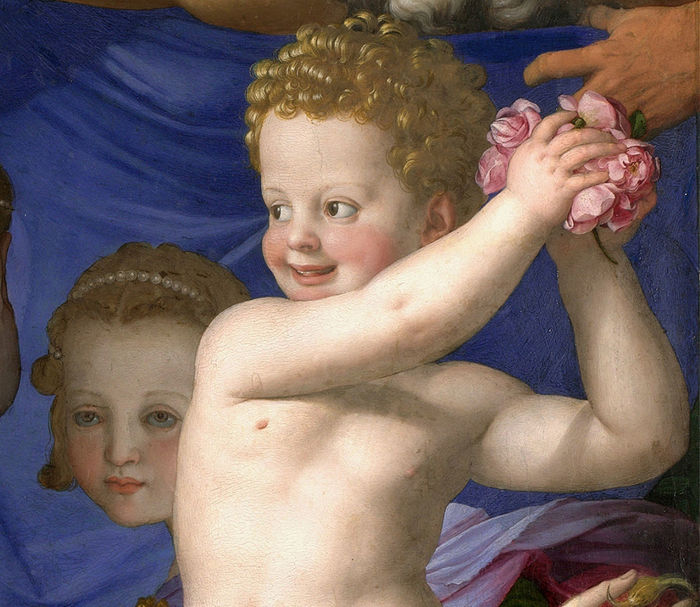
Folly and Pleasure
On the right appears a cheerful, almost innocent boy who throws rose petals while stepping on a thorn. Depending on the reading, he is known as Folly or Pleasure. He represents the recklessness and impulsiveness of lovers, who often act without thinking of the consequences. He is playful, colorful and apparently harmless, but his role is far more dangerous: everything seems sweet while the flowers fall, yet the thorn is already in his foot. The painting thus turns pleasure into a trap, where the pleasant and the painful happen at the same time.
Time and Oblivion
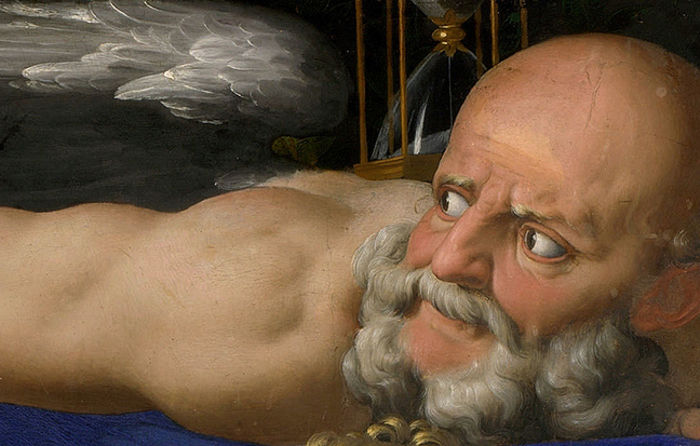
In the upper right corner we find Chronos, or Time, a winged old man with an hourglass on his back, pulling at a cloth to uncover the scene. On the other side, Oblivion, a figure with no back to her head, tries to cover it again. The entire scene is caught between those two forces: one that wants to reveal and one that wants to make things disappear.
The image fits the course of syphilis itself. After infection comes a latent period in which the symptoms vanish and the patient believes he is cured. But Time reveals what the body tries to hide. In the context of the painting, Chronos reminds us that although love and passion can be intense, they are destined to fade, and that with the passing of time everything comes to light.
Deceit and the Masks
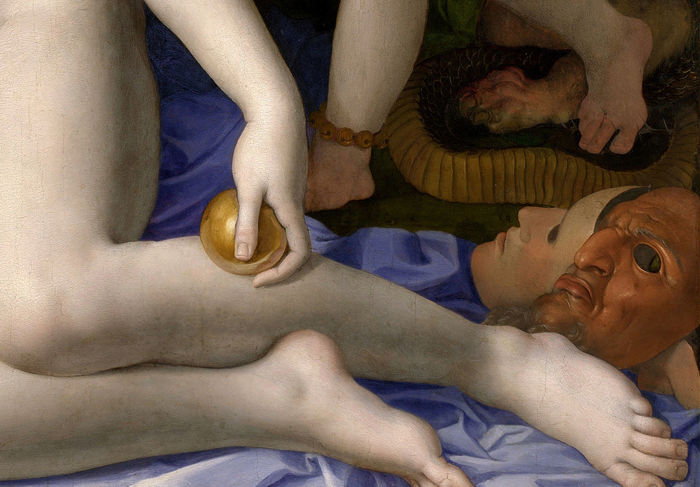
Behind the boy appears an even stranger creature. She has a young, beautiful face, but her body ends in a reptile's tail. In one hand she offers a honeycomb, and with the other she hides a stinger. She is Deceit. The honey attracts; the stinger lies in wait. This duality shows the double face of love, which can be sweet and bitter at once, a symbol of the attraction and repulsion of desire. Bronzino places her practically next to Venus and Cupid, as if she were a natural part of the seduction scene.
At the couple's feet there are also some masks. They seem part of the game of love, but they also speak of deception: desire can disguise itself as pleasure while something else is happening underneath.
A Gift for a King
The work was made around 1545 at the court of Cosimo I de' Medici and was sent as a gift to Francis I of France. And there is something particularly unsettling about that gift.
Francis I was said to have syphilis, a disease known in Italy as the "French disease", while in France it could be called the "Italian disease". The illness had become trapped in that war of names and blame between countries.
So Bronzino may have painted for a king a work seemingly devoted to love, pleasure and beauty. But beneath that surface another story could be hiding: desire attracts, pleasure deceives, time uncovers, and what seemed to have disappeared can return as suffering. A perfect gift for a king. And a disease hidden inside the gift.
Bronzino's Style and Technique
Bronzino, one of the most outstanding exponents of Mannerism, uses in this work an impressive technique marked by precision and perfectionism. The Mannerist style is characterized by sophistication, the use of intense colors and the distortion of proportions in pursuit of visual drama. Here, Bronzino captures the viewer's attention not only through the erotic content of the work but through the tension and complexity he gives to every figure.
The pale, almost marble-like skin of Venus and Cupid contrasts with the vivid colors and intricate details of the secondary characters. This contrast heightens the drama and underlines the disquieting atmosphere of the scene. Bronzino's skill in creating textures and minute details, such as the folds of the fabrics or the curls of the hair, adds an almost supernatural realism, trapping the viewer in a scene that seems both real and fantastical.
That is Bronzino's trap. The viewer comes in drawn by the beauty of the bodies, the intense blue, the luxury of the details and that impossible kiss between Venus and her son. But the longer one stays in front of the painting, the more uncomfortable the scene becomes.
The work has been subject to many interpretations over the centuries. Although its explicit eroticism and its portrayal of taboo themes have caused controversy, it is also seen as a profound allegory of the complexities of love and desire. For some critics it is a warning about the dangers of uncontrolled love and the suffering that obsession brings; for others, as we have seen, it is also an allegory of disease. Perhaps Bronzino meant both at once.
The presence of Time also suggests a message of hope: although the folly of love can blind us and deceit can seduce us, time is always present, waiting for the moment of its final revelation. It is a reminder that, however tempting desire and passion may be, only clarity and time can show us the way.
Through this work, Bronzino creates an image that attracts and disturbs at the same time, a visual riddle that invites us to reflect on the deepest human impulses and the forces that guide and control us.
THE ARTWORK
Venus, Cupid, Folly and Time or Allegory of the Triumph of Venus
Bronzino
Year c. 1545
Technique Oil on panel
Style Mannerism
Size 146 cm × 116 cm
Location National Gallery
London