

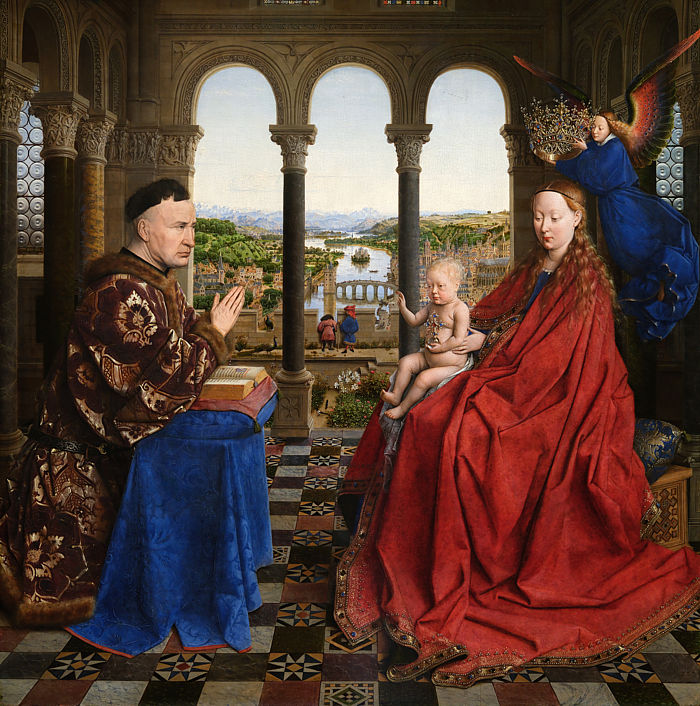
In 1435, a man who knew he was nearing the end of his life commissioned a painting. He didn't ask for an epic scene or an imposing portrait of his power. He asked for something more intimate: to appear kneeling, face to face with the Virgin Mary, as if that audience could be bought with enough money and enough faith.
The result was a panel measuring barely 66 by 62 centimeters that, almost six hundred years later, still raises questions even Louvre specialists haven't fully answered. It's called The Virgin of Chancellor Rolin, and it was painted by Jan van Eyck.
Who Nicolas Rolin was, and why he commissioned the painting
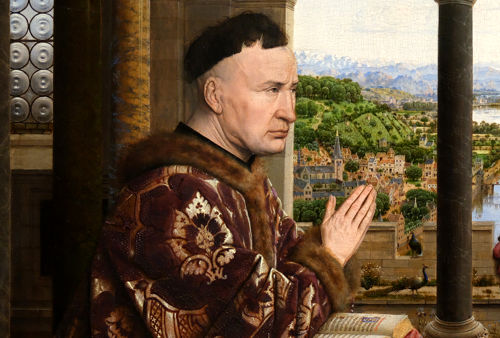
Nicolas Rolin was no ordinary nobleman. He was chancellor to the Duke of Burgundy, Philip the Good — the closest equivalent today would be something like a prime minister. He controlled a large share of the political and economic power of one of the wealthiest territories in 15th-century Europe. He commissioned this painting for the collegiate church of Notre-Dame in Autun, the city where his parents were buried and where he himself had been born. It wasn't only an act of religious devotion: it was also a way of publicly asserting his power, his wealth, and his closeness to the sacred, at a point in his life when he was already thinking about his own death and the salvation of his soul.
Jan van Eyck, the painter who redefined oil painting
Van Eyck worked as a court painter for the same Philip the Good, which likely facilitated the connection with Rolin. For a long time he was credited with inventing oil painting itself. Historians today qualify that claim: the technique already existed, but Van Eyck was among the first to master and perfect it to a level of detail his contemporaries hadn't reached. He was also one of the first painters to sign his works, something almost no one did at the time. His most famous painting, The Arnolfini Portrait, shows the same obsession with minuscule detail found in the Rolin panel.
A scene that broke the rules
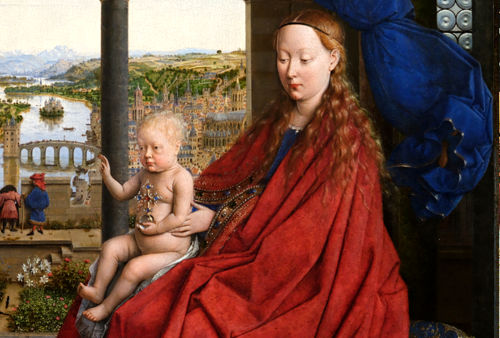
The first thing that stands out when looking at the full painting is something that goes unnoticed today but was almost provocative in 1435. Rolin is painted at exactly the same scale as the Virgin. He faces her, at her same height, looking directly at her. Until that point, pictorial convention was clear: the donor who paid for a religious painting was shown smaller than the sacred figures, and almost never appeared alone before them. An intermediary saint was required, usually the donor's namesake, to present him. In this painting there is no intermediary at all. Rolin paid for a direct audience with the mother of God, with no one speaking on his behalf.
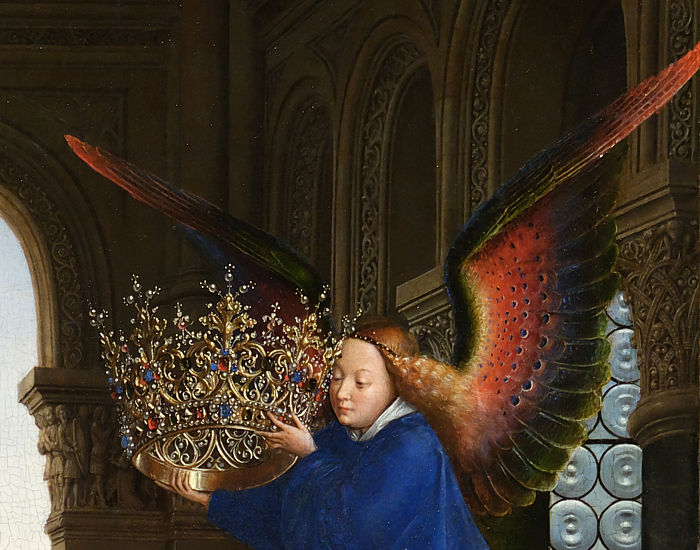
The composition also divides the space symbolically: the earthly world, where Rolin stands, on one side; the spiritual world, where the Virgin, the child, and an angel holding a crown of gold and precious stones appear, on the other. A river marks the boundary between the two. The arcades separating the scene from the landscape outside are three in number, a figure that in medieval Christian symbolism refers directly to the Trinity.
The landscape no one has fully deciphered
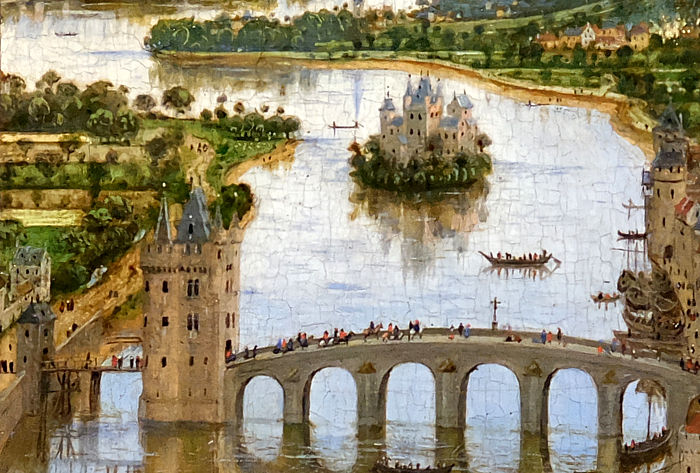
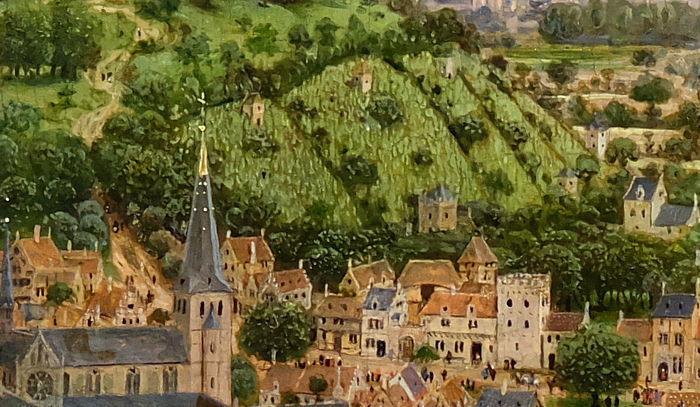
Behind the two figures, a landscape opens up that occupies a tiny fraction of the panel and yet holds an almost overwhelming amount of detail. There's a bridge with people crossing it, one figure at a time. There are boats on the river, complete with sails and oars. There are windows, towers, bell towers, and even the inverted reflections of the buildings on the water, painted with an optical accuracy that anticipates centuries of scientific study on how light behaves on a liquid surface. No one knows for certain how Van Eyck achieved that precision without optical instruments. There's an open academic debate over whether Flemish painters of this period may have used mirrors or early lenses, but there's no conclusive evidence either way.
For a long time it was assumed that this city represented Autun, Rolin's hometown and the painting's original destination. That reading is now disputed. Identifications with Liège, Maastricht, and Utrecht have also been proposed, none fully confirmed. The interpretation that carries the most weight among specialists today is that it isn't any real city at all, but an idealized one, built by combining recognizable architectural elements from different places. Some historians go further and read the two halves divided by the river as a reference to the two cities described by Saint Augustine: the earthly city and the city of God. Under this reading, the landscape wouldn't be depicting a geographic location, but a theological idea.
The bridge and the shadow of a political murder
The element that seems most neutral in the whole scene, the bridge, is probably the most loaded with meaning. Some historians link it to the bridge at Montereau, where in 1419 John the Fearless, Duke of Burgundy and father of Philip the Good, was assassinated. That crime triggered years of civil war between Burgundy and France. Peace finally came in 1435, the same year this painting was made, with the Treaty of Arras — negotiated precisely by Nicolas Rolin. If this reading is correct, the greatest political achievement of Rolin's life is hidden in a fragment of landscape the size of a fingernail, within the very painting where he asks for the salvation of his soul.
The symbols hidden in stone and in the garden
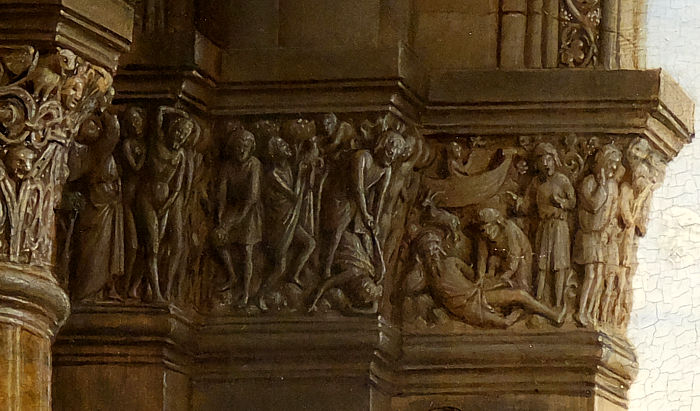
Just above Rolin's head, carved into the column capitals, are three scenes from the Old Testament: Adam and Eve expelled from paradise, Cain killing Abel, and Noah humiliated by drunkenness. These aren't mere architectural ornaments: they are the three great falls of man in Christian tradition, deliberately placed above the head of the man asking for forgiveness.
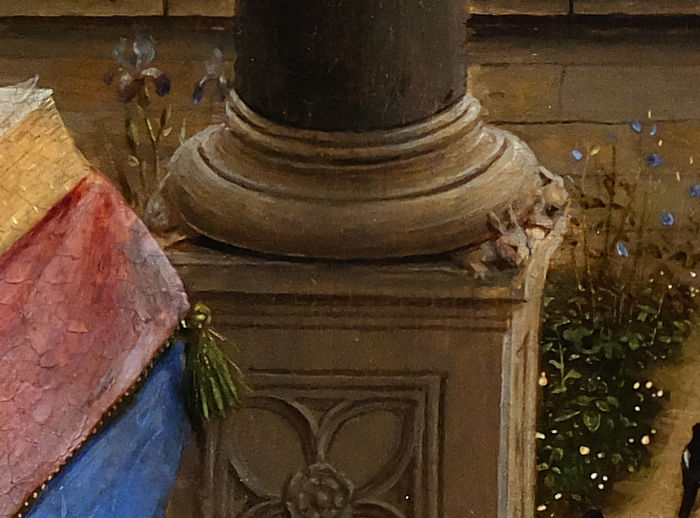
At the base of the columns, almost impossible to make out without zooming in, there are carved rabbits. In medieval iconography, the rabbit was not an innocent animal: it was associated with carnal desire and the weakness of the flesh. Some specialists suggest they were deliberately shown crushed under the weight of the architecture, as an image of sin overcome by faith — though it's worth clarifying that this is an interpretation, not a documented fact about the painter's intentions.
The garden seen in the background is also full of floral symbolism, a common device in 15th-century Flemish religious painting, where each plant referred to a virtue or an episode linked to the Virgin.
The two figures the Louvre still can't identify
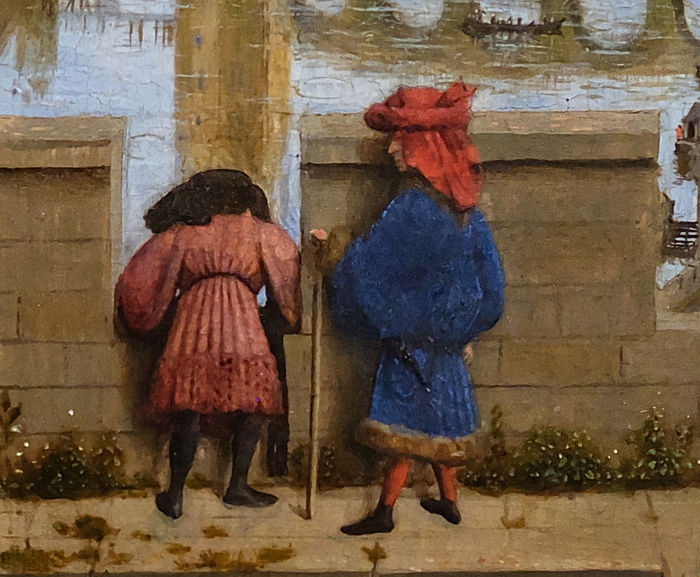
The detail that generates the most discussion is at the back of the garden, on a terrace, seen from behind: two tiny men, one dressed in blue and the other in red. It's common to find the claim that the figure in red is a hidden self-portrait of Van Eyck. It's an attractive hypothesis, but it hasn't been proven. When the Louvre organized a full exhibition dedicated to this painting in 2024, following its first deep restoration since entering the collection in 1805, the identity of these two figures still appeared among the work's open questions — framed that way by the institution itself. Not as a settled answer, but as a mystery that remains unresolved.
A restoration that brought back the light
That restoration, completed for the Louvre's 2024 exhibition, removed layers of oxidized varnish that had darkened much of the painting for centuries. The process revealed the background landscape's details with greater sharpness, the original brilliance of the Virgin's crown, and the near-miniaturist precision with which Van Eyck worked every centimeter of the panel. In a sense, it was the first time in more than two centuries that the public could see the painting with a fidelity close to what Rolin himself saw the day he received it.
A powerful man paid to secure himself a place in eternity. The painter gave him something he probably never fully saw himself: an entire city that fits in the space of a coin, a political murder hidden in a bridge, and two figures with their backs turned that, almost six hundred years later, the most visited museum in the world still can't identify with certainty.
THE ARTWORK
The Virgin of Chancellor Rolin
Jan van Eyck
(circa 1390–1441)
Religious genre