

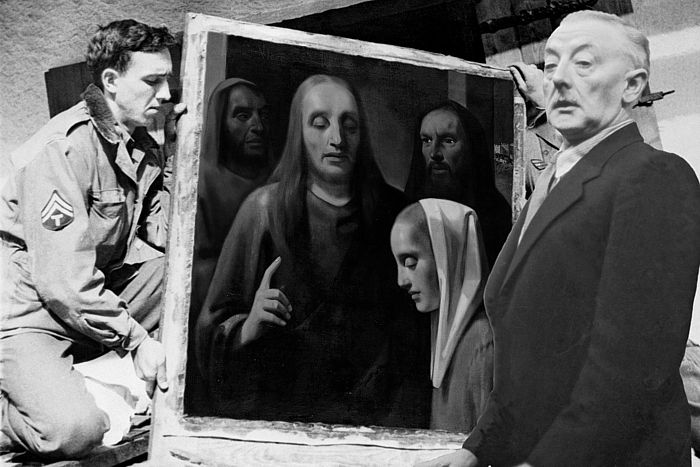
Imagine the scene: it is the end of World War II, and the Allies are recovering artistic treasures stolen by the high command of the Third Reich. Among the lavish collection of Hermann Göring, the second most powerful man in Nazi Germany, they find a jewel that leaves experts breathless: "Christ and the Adulteress," an unknown work by the Dutch master Johannes Vermeer. The discovery is historic, but it hides a secret that is about to unleash the greatest scandal in art history.
The trail of the painting led authorities to a man named Han van Meegeren, a Dutch artist who lived in inexplicable luxury. He was immediately arrested under a very serious charge: collaboration with the enemy and the sale of national heritage. In post-war Europe, that meant only one thing: the death penalty. However, in the middle of the interrogation, Van Meegeren let out a laugh and uttered a sentence that changed everything: "Selling national heritage? Don't be fools, I painted that picture myself." Thus began the story of the man who not only deceived the Nazis but turned the entire world art system into a laughingstock.
The Birth of a Revenge
To understand why Han van Meegeren did what he did, one must understand his frustration. Han was an artist with exceptional technical talent, but he had been born in the wrong era. While he loved the realism, light, and technique of the 17th-century masters, the art world was obsessed with Cubism, Surrealism, and abstraction. Critics tore him apart, calling him "mediocre" and "a simple imitator of the past."
Wounded in his pride, Van Meegeren decided that if he couldn't be famous for his own name, he would be famous for his ability to surpass the greatest. He decided to take revenge on the critics by showing them that they didn't know how to distinguish an authentic masterpiece from a modern forgery. But he didn't want to make a copy of an existing painting; he wanted to create a "new" Vermeer, a lost work that would fit perfectly into the gaps of the artist's history. And to do that, he needed to become an alchemist.
The Alchemy of Lies: How to Deceive Time
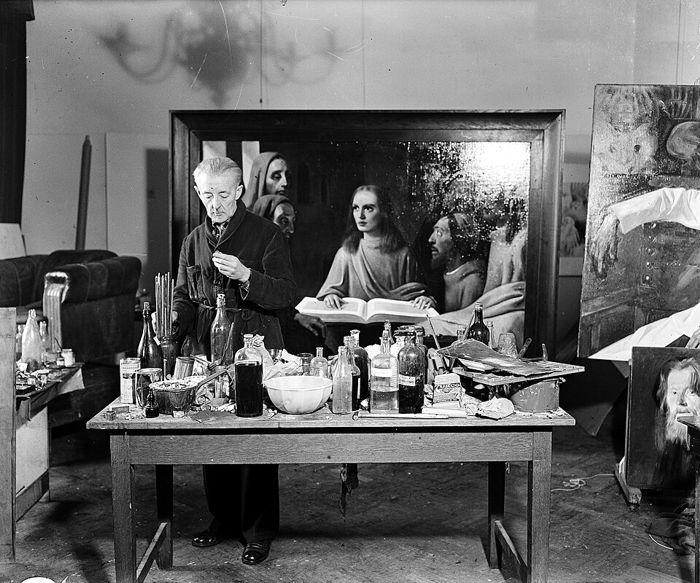
Forging a Vermeer was no easy task. Experts in the 1930s were already using chemical tests to detect fraud. If the paint wasn't dry all the way through, or if the pigments contained modern substances, the deception would be discovered in seconds. Van Meegeren spent years experimenting in his secret laboratory.
He bought original 17th-century canvases by minor artists, carefully scraped off the old paint, and kept the original support. But the real trick was the binder. Instead of linseed oil, he used a mixture of phenol resin and formaldehyde (similar to plastic). After painting, he placed the picture in a temperature-controlled oven to harden the resin. The result was a layer of paint so hard and brittle that, when swiped with alcohol or a solvent, it wouldn't budge—just as it would with a 300-year-old painting.
For the famous cracks (craquelure), he rolled the canvas over a cylinder, forcing the appearance of fissures that he then filled with India ink so they would look like centuries of accumulated dust. The deception was perfect. Not even the microscopes of the time could tell the difference.
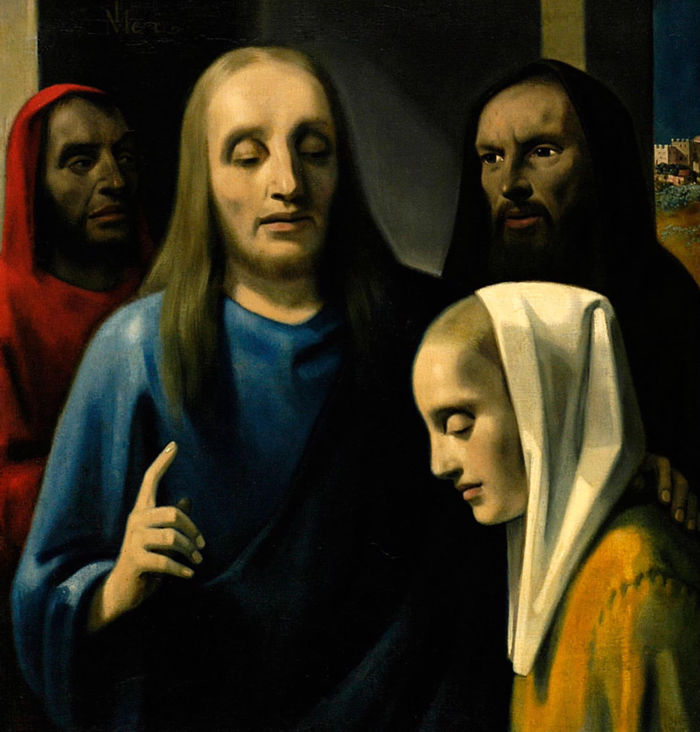
"The Disciples at Emmaus": The Masterstroke
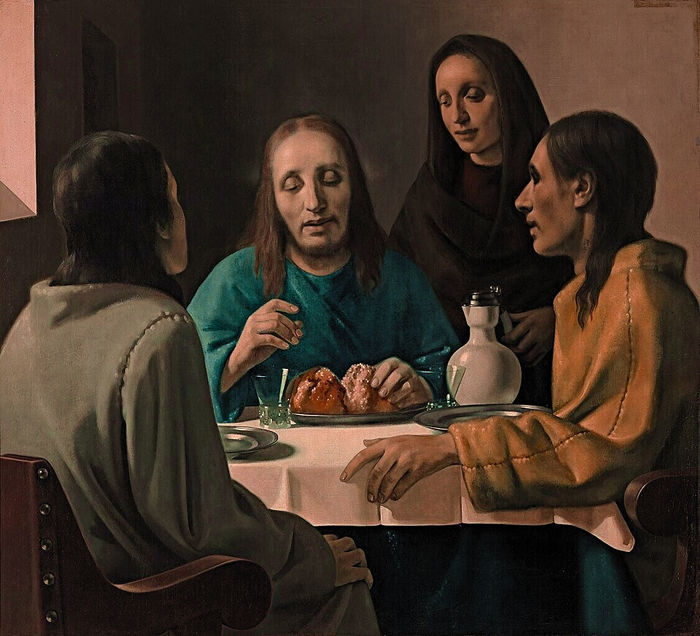
His first great test was a painting titled "The Disciples at Emmaus." He presented it as a work from Vermeer's early period. Dr. Abraham Bredius, the world's foremost Vermeer expert, fell hook, line, and sinker for the trap. He declared it was "the masterpiece of Johannes Vermeer" and that it was the most exciting moment of his professional life. The painting was bought for a fortune and hung with honors in the Boymans Museum in Rotterdam.
Van Meegeren had won. The same critics who called him mediocre now adored his brushstrokes, thinking they belonged to a dead genius. It was at that moment that revenge turned into an extremely lucrative business. He began to churn out "Vermeers" like loaves of bread, earning the equivalent of millions of today's dollars.
The Nazi Who Was Scammed
During the German occupation of the Netherlands, Han saw a golden opportunity. Hermann Göring, a man obsessed with accumulating art (and especially with owning a Vermeer, the ultimate symbol of Germanic purity for the Nazis), was desperately looking for a piece for his collection. Through intermediaries, Van Meegeren sold him "Christ and the Adulteress."
Göring was so happy with his acquisition that he gave 137 stolen works of art in exchange to complete the payment. What the Nazi didn't know was that he was handing over real treasures in exchange for a canvas painted in a garage a few months earlier with synthetic resin. This irony of fate was what, years later, would turn a forger into a Dutch national hero.
A Trial That Paralyzed the World
When the war ended and Van Meegeren was arrested, he realized that if he kept the secret, he would be shot for treason. So he confessed. But nobody believed him. Experts, to protect their own reputations, insisted the paintings were authentic. "It is impossible for a modern man to have painted this," they said.
To prove his innocence, the judge ordered an unprecedented test: Van Meegeren would have to paint a new "Vermeer" in his cell, under the supervision of guards and experts. For weeks, under unimaginable pressure, Han painted "Jesus Among the Doctors." When he finished, there was no longer any doubt. The man was a genius of forgery.
The trial was a media circus. Van Meegeren went from being a hated traitor to a folk hero who had conned the "monster" Göring. People celebrated that a Dutch artist had fooled the Reich with fresh paint.
The Great Question: What is Art?
The Han van Meegeren case left an open wound in the art world that has never quite closed. It posed a fascinating philosophical dilemma: If a painting is aesthetically perfect, if it moves experts and the public alike, why does it lose all its value the moment we discover the signature is fake? Are we admiring the work, or are we admiring the name?
Han died of a heart attack shortly before entering prison, but his legacy lives on. Today, his own forgeries are collector's items and are auctioned for considerable sums. Ironically, the man who wanted to be a great classical artist ended up being the father of the art of doubt.
This story reminds us that, sometimes, reality is much stranger than fiction and that, in the world of auctions and museums, the line between genius and fraud is as thin as a brush hair.