

There is a house on the outskirts of Madrid that kept fourteen nightmares painted directly onto its plaster walls. It was bought by a seventy-two-year-old man, deaf, widowed, and marked by an illness that had nearly killed him. His name was Francisco de Goya, and what he painted there was not made for a king, a church, or a collector. He made it for himself.
Today we know them as the Black Paintings, and they hang in the Prado Museum. But they began as something far more intimate and strange: the decoration of a house where an old man sat down to eat surrounded by his own fears. To walk through them is to step inside the mind of a genius at the exact moment he stopped believing in almost everything.
A House Called the House of the Deaf Man
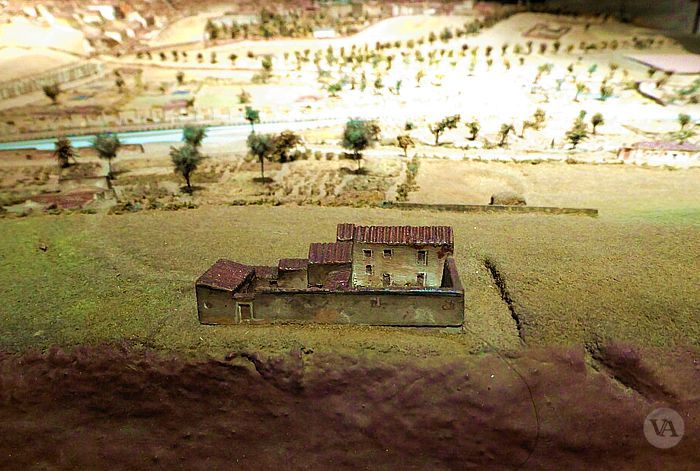
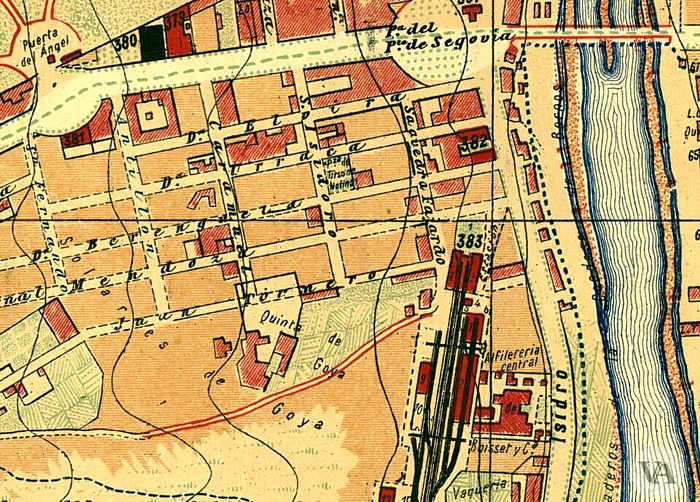
On February 27, 1819, Goya bought a country estate beside the Manzanares River, near the Segovia Bridge. The place was already known as the Quinta del Sordo, "the Deaf Man's House," after a previous owner, but the coincidence seemed written on purpose: the new owner had been unable to hear for almost three decades, ever since his illness of 1793. That silence, which began as a misfortune, ended up becoming his way of looking at the world.
He arrived at that house with his life in pieces. He had been a court painter and portraitist to kings, but the War of Independence showed him what the royal salons never taught. In 1814 Ferdinand VII returned, the people welcomed him with cheers and cries of "long live the chains," and Goya, a sympathizer of Enlightenment ideas, saw that those who had suffered the war were applauding the man who was about to oppress them. The Inquisition, as if that were not enough, had summoned him in 1815 over his majas. Of his children, only one reached adulthood. And in 1819 he fell so gravely ill that he survived only thanks to his doctor, Arrieta, whom he portrayed the following year in a painting of gratitude where death still hovers around the bed.
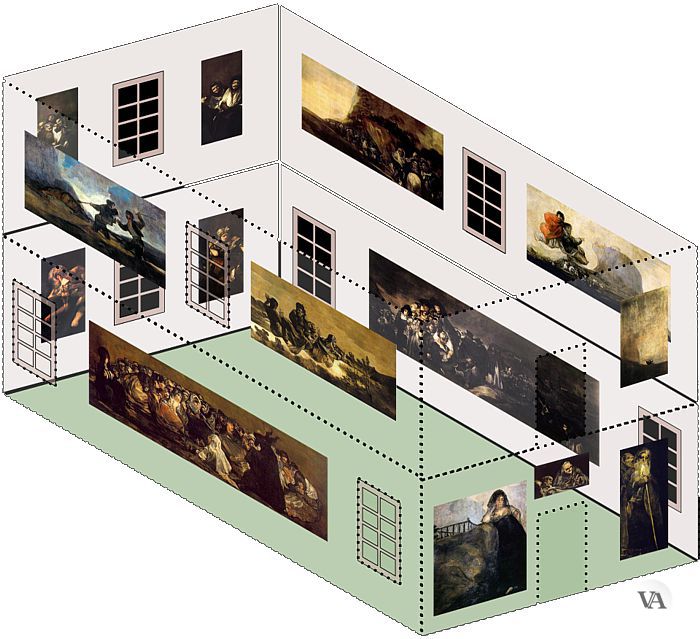
In the house he lived with Leocadia Weiss, his housekeeper and companion, who was married to another man. Between 1820 and 1823 he covered the walls of two floors using an unusual technique: oil applied over dry plaster, in a range of ochres, grays, earth tones, and blacks. Technical studies revealed something that changes the reading of the whole series: beneath the paintings lay bright landscapes. Goya covered them up. The darkness was not his starting point. It was a decision.
Dining Under Saturn's Gaze
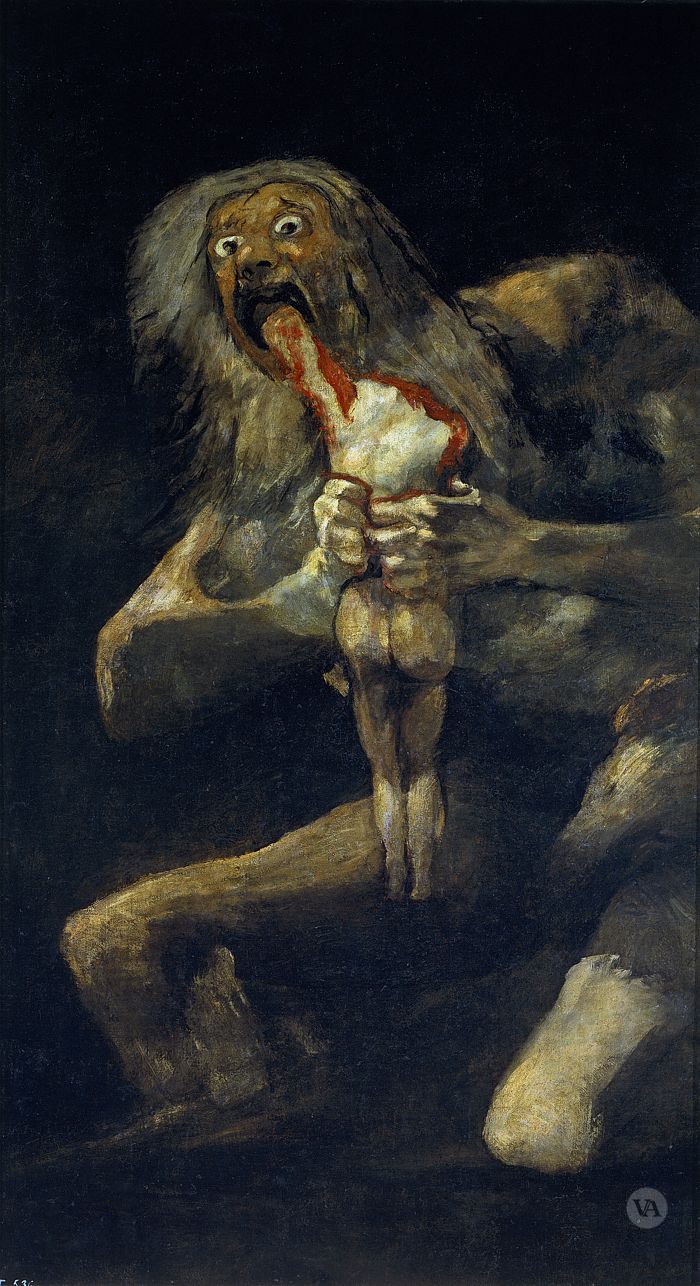
The most famous image of the series, Saturn Devouring His Son, hung in the room where the household ate. That placement defines its meaning. Saturn, a canvas of just under a meter and a half in height, emerges from a black background with bulging eyes and an open mouth, gripping a headless body in his hands. Rubens had already painted the myth, but with the elegant distance of mythology. Goya moves it into panic.
The most powerful reading is political. Saturn is absolute power, and in 1823 that power had a name and a face: Ferdinand VII, who had just recovered the throne and was beginning to persecute the very liberals who had defended the country. But Goya does not paint a tyrant sure of himself. He paints a terrified one, who devours what he should protect most out of fear of losing what he has. It is the image of a country that eats its own children. And there is a second, more intimate layer, for a man who had buried almost all of his own: that of a father who outlives his offspring while time, the Saturn of the ancients, chews on him.
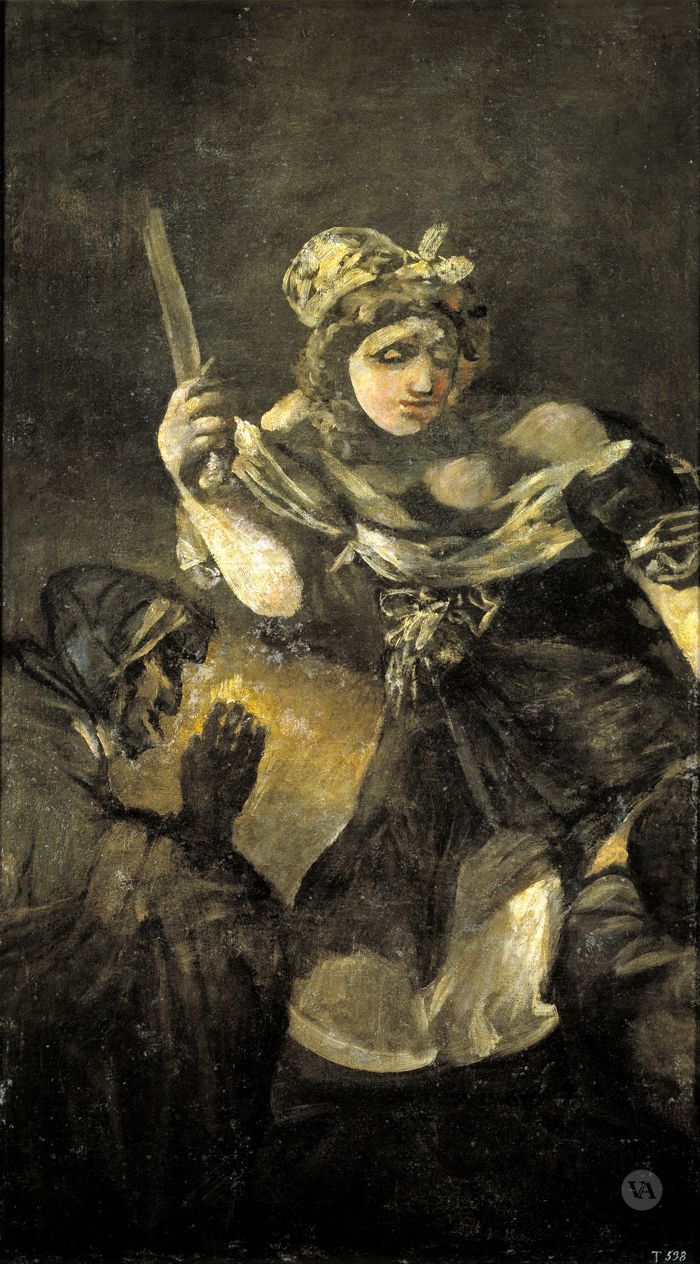
In the same dining room, opposite the door, Goya placed Judith, the biblical heroine who cuts off the head of the general besieging her city. She appears as a woman with a sword in her hand beside the body of her victim, and the scene has no glory: there is haste, shadow, an act committed in secret. It is a liberal's wish that someone stop the monster, and at the same time the certainty that no one will do it without getting stained. Between the god who devours and the woman who kills, Goya ate every day between two forms of violence.
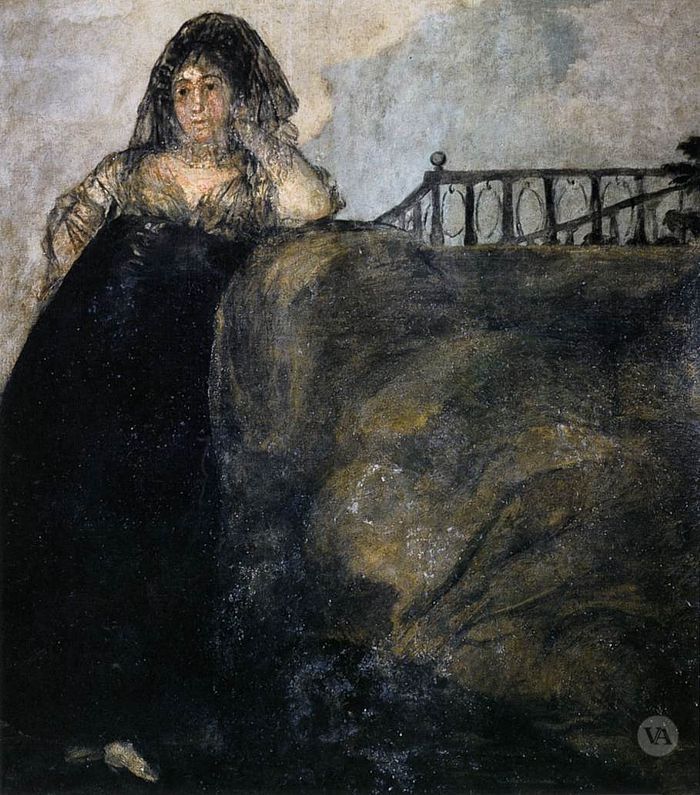
The third image of the dining room is the calmest and the saddest. La Leocadia shows a woman in black, leaning on what looks like a tomb, with an expression we cannot decipher. She is Leocadia Weiss. There is no tenderness or comfort in her, but something harder: mourning in advance. Goya paints her in mourning before he dies, because he knows she will be the one left behind. X-rays also reveal a male figure beneath her portrait, which the painter chose to cover. Amid so much horror, the only human presence close to him already comes dressed for farewell.
Death as a Companion
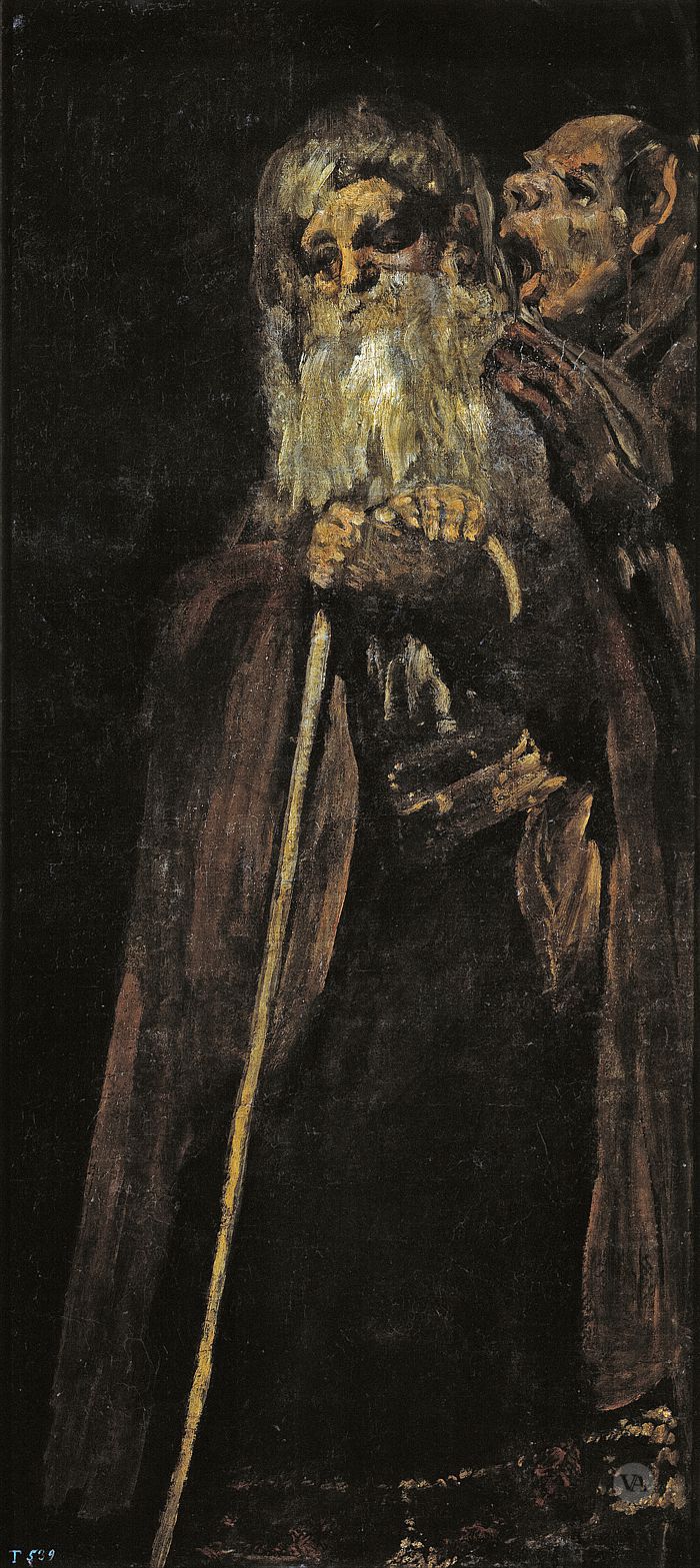
Another work from the dining room, Two Old Men, hung opposite Judith. A hunched elder leans on a cane while another, pressed to his ear, speaks to him. It is deafness turned into an image: Goya, who could not hear, paints a voice that exists only inside the head. The one whispering is death, or conscience, or the half of oneself that has already accepted the end. What unsettles is that we do not know what it says. And that unanswered question is the real subject.
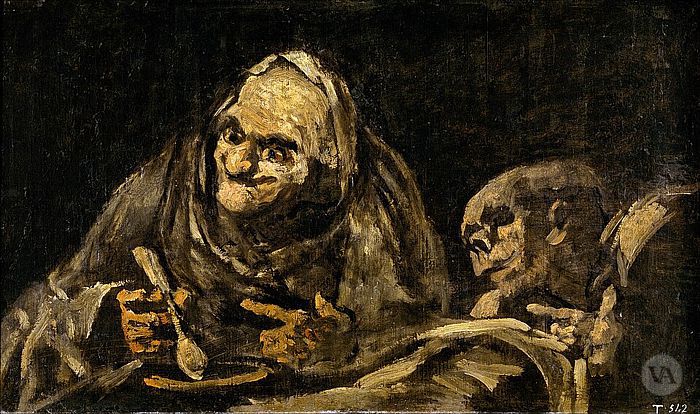
In Two Old Men Eating Soup, death is already seated at the table. One of the elders has the face of a skull, with an open mouth and sunken gaze, and shares with his companion a bowl that no one seems to enjoy. For a man who had just brushed against the end in his own bed, death was not a blow but a habit, a patient guest who arrives and stays.
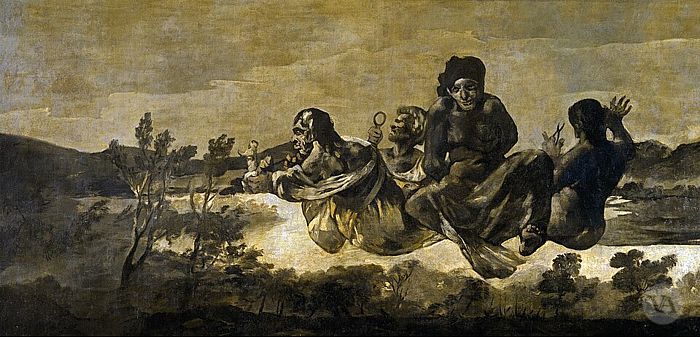
In Atropos or The Fates, that presence receives a name. Atropos is the Fate who cuts the thread of life, and Goya makes her float over a desolate landscape alongside her sisters, deciding who goes on and who does not. Here fate stops being abstract: it has scissors.
A Country Sinking
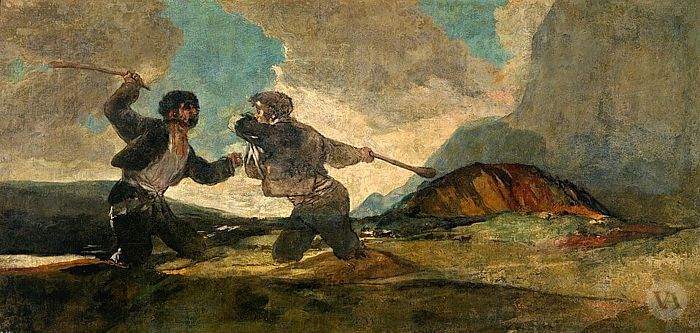
If the earlier works are one man's fear, these are a country's fear. Fight with Cudgels shows two men beating each other with sticks while sunk to their knees in the earth. Each blow sinks them deeper, neither can flee, and neither can win. Goya had watched Spain go, in ten years, from the war against Napoleon to the restoration, the liberal triennium, and a new restoration. Always the same people, Spaniards against Spaniards, while the ground swallowed them. He takes no side. He paints the trap.
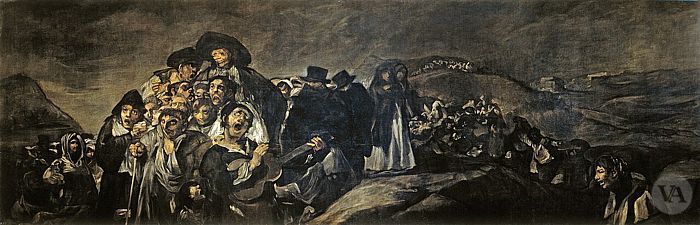
The Pilgrimage of San Isidro is his great self-correction. In 1788 he had painted that same festival, in a tapestry cartoon, as a bright day of clean clothes and green meadow. Thirty years later he returns to the same place and nothing of that joy is left: a crowd of open mouths and deformed faces singing in the dark without knowing where it is going. They are the same people who shouted "long live the chains." Goya no longer paints the people as hope, but as a blind chorus.
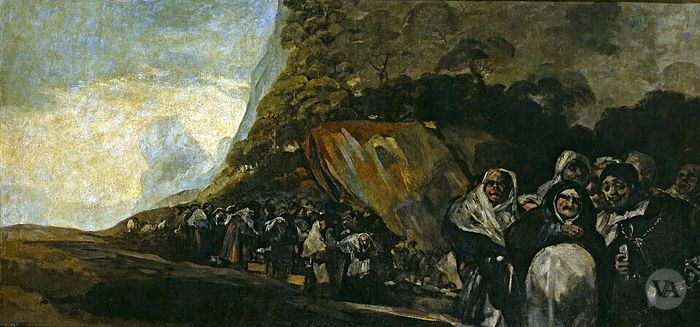
The Pilgrimage to the Holy Office advances toward the viewer as a procession of grotesque faces, with empty eyes and twisted mouths. Goya knew the Inquisition from the inside, and he learned something worse than its cruelty: that fear does not need many executioners, a docile crowd is enough. That is why the scene does not portray the inquisitors, it portrays everyone else.
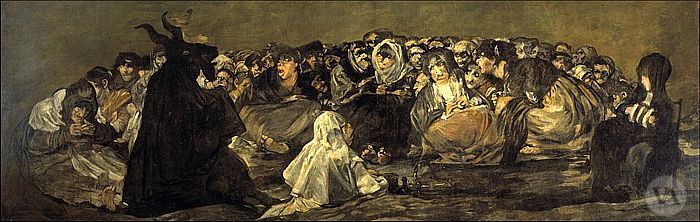
Witches' Sabbath, which he himself had painted with irony decades earlier, returns without a trace of humor. A he-goat presides over a circle of faces that listen to him with devotion. The devil does not need strength, only listeners.
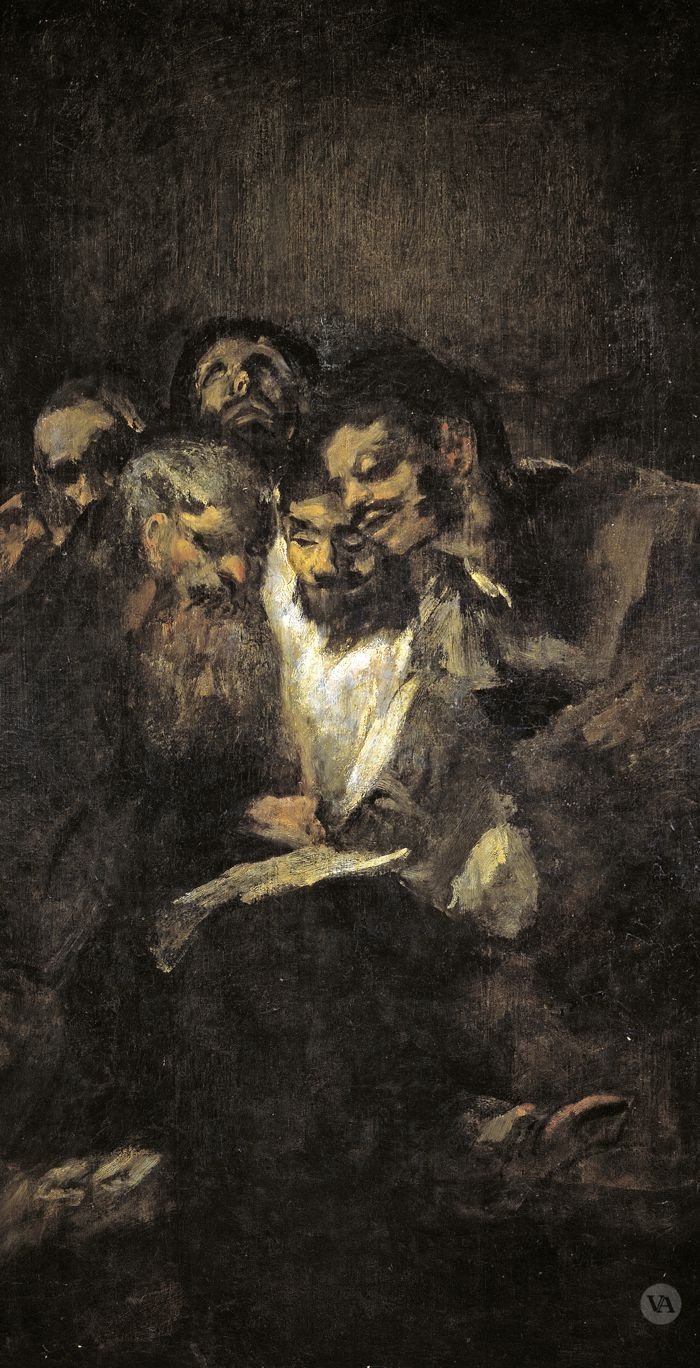
And in Men Reading, the quietest of the scenes, a group listens, absorbed, to someone reading aloud. There is no visible violence, and that is why it disturbs: the calm obedience of those who believe whatever they are read.
Voices, Laughter, and a Dog
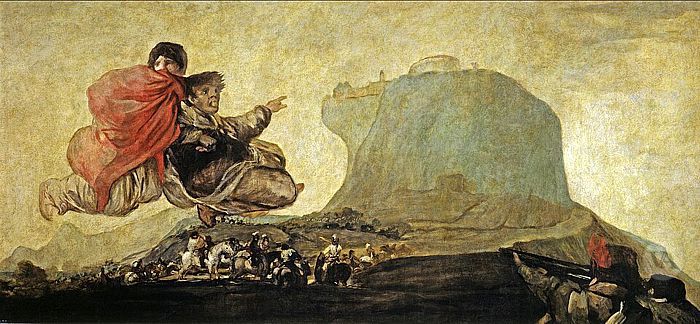
The last works drift away from reality, as if Goya could no longer hold on to it. In Fantastic Vision, also called Asmodea, two figures fly over a landscape where everything below shrinks. It is the wish to escape, to look at war from so high that it seems a game. Soon after, Goya did exactly that and left Spain, never to live there again. The painting was an omen.
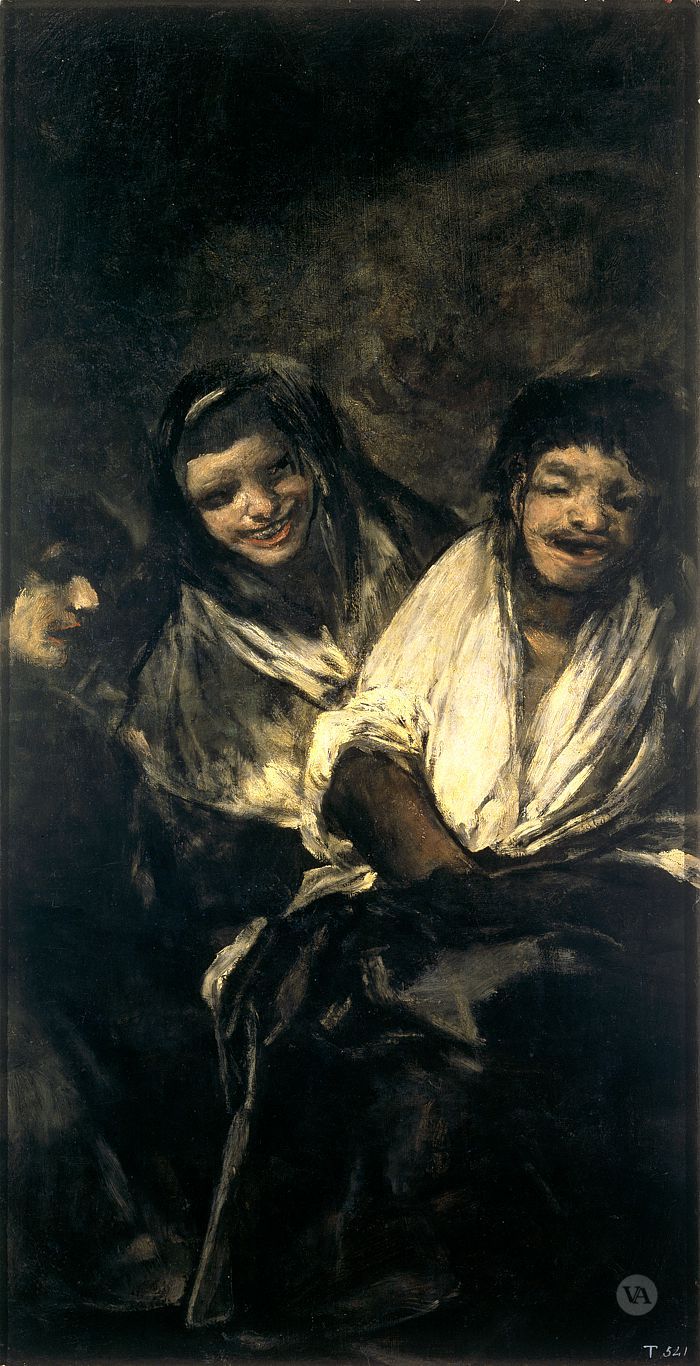
Women Laughing brings together two women roaring with laughter beside a man who watches them. It is the only laughter in the entire house and the most uncomfortable, because it does not console. It is the laughter of someone who enjoys another's pain, or of someone who has seen so much that all that is left is to laugh.
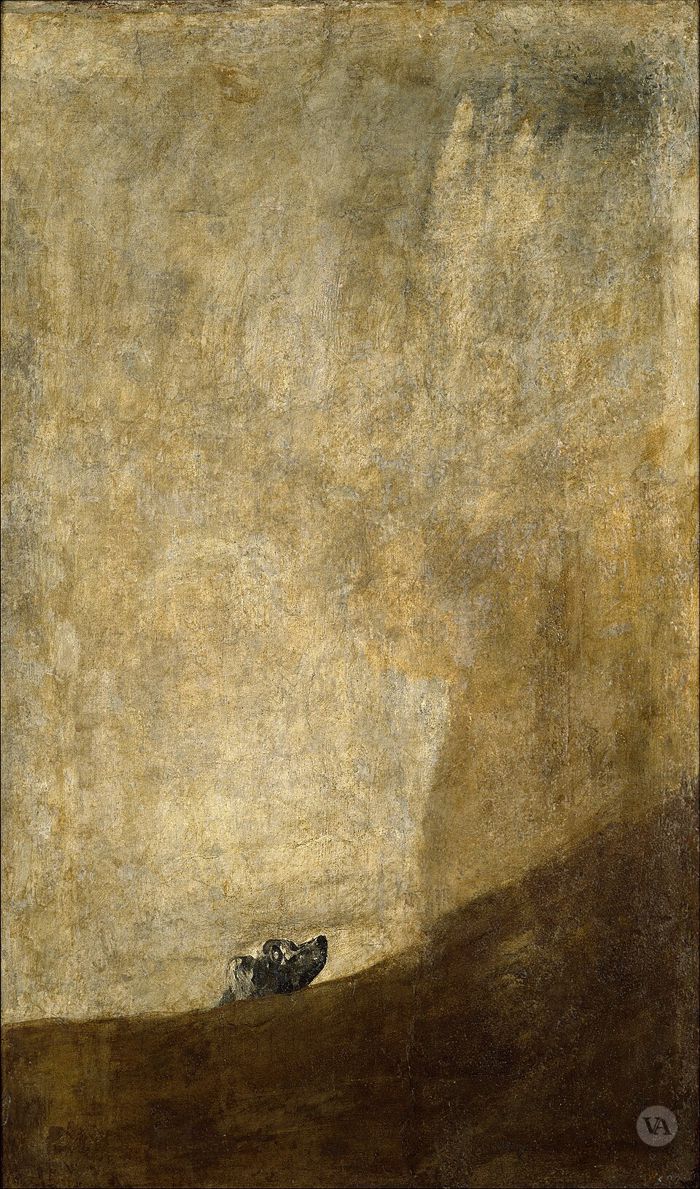
And closing the series, for many, is The Dog: just the head of an animal peeking above an empty sky, looking up at no one. After kings, gods, executioners, and crowds, Goya ends with the smallest thing. There are no culprits in that scene, only someone asking for help who does not know whether an answer will come. It is the simplest of the fourteen paintings and the most modern, the one that hurts the most.
From the Wall to the Museum
Goya never gave them titles. The names we use come from the inventory made in 1828, after his death, by his friend Antonio de Brugada. In 1823 the painter had ceded the house to his grandson Mariano, and in 1824 he left for France, where he died in Bordeaux. The paintings stayed on the walls, exposed to damp and neglect.
Their rescue was almost as dramatic as their creation. When Baron Émile d'Erlanger bought the estate, he commissioned Salvador Martínez Cubells, the Prado's restorer, to remove the murals and transfer them to canvas, an extremely delicate job carried out around 1873 and 1874. The works traveled to the 1878 Paris World's Fair and, in 1881, the baron donated them to the Spanish state. They have been in the Prado ever since.
We will never know for certain what Goya meant in each of them, and perhaps that was his final act of freedom. This is one possible reading, and yours may be different. But something remains in all of them: more than two centuries later, these fourteen images keep looking back at us.
THE ARTWORKS
Saturn Devouring His Son, 1820-1823
Judith and Holofernes, 1820-1823
La Leocadia (A Manola: Doña Leocadia Zorrilla), 1820-1823
Two Old Men, 1820-1823
Two Old Men Eating Soup, 1820-1823
Atropos or The Fates, 1820-1823
Fight with Cudgels, 1820-1823
The Pilgrimage of San Isidro, 1820-1823
Pilgrimage to the Holy Office, 1820-1823
Witches' Sabbath, 1820-1823
Men Reading, Two Men, The Reading or The Politicians, 1820-1823
Fantastic Vision (Asmodea), 1820-1823
Women Laughing, 1820-1823
The Dog, 1820-1823