

Imagine walking into the Sistine Chapel. There is silence, or something close to it, because hundreds of people are breathing with their heads tilted back. Everyone is looking for Michelangelo's ceiling, the finger of Adam, the God stretching out through the clouds. Few lower their eyes to the altar wall, where the Last Judgment unfolds like a storm of bodies. And almost no one knows that beneath that storm there was once another wall: a serene, luminous wall, painted by a man whose name hardly rings a bell today.
That man was Pietro Vannucci. History remembers him as Perugino. He was a workshop companion of Leonardo da Vinci, the teacher of Raphael, and one of the most sought-after painters in Italy. And his most important work in Rome disappeared beneath Michelangelo's brush.
The Boy from Umbria
Pietro was born around 1450 in Città della Pieve, a village of gentle hills in Umbria, in the heart of Italy. It is a land of long roads, orderly fields and a sky that seems larger than anywhere else. That quiet light would stay with him all his life. Years later, in every painting he made, that open horizon would return, like a memory that refuses to leave.
Little is known about his childhood, and what is told usually comes from later biographers. What seems clear is that his family was not wealthy and that the boy showed an early talent for drawing. His earliest training is debated among specialists, but they all agree on one point: to become a great painter, you had to go to Florence.
And Pietro went.
The Workshop Where Everything Crossed Paths
Florence in the second half of the fifteenth century was an extraordinary place. The Medici ruled the city, bankers paid for monumental works, and the artists' workshops operated like small factories of genius. In one of them, that of Andrea del Verrocchio, tradition places the young Perugino.
Verrocchio was a sculptor, goldsmith and painter, and his workshop was a school for everything imaginable. There you learned to cast bronze, to draw the human body, to mix pigments, to build space with perspective. And according to the same tradition, in those very rooms worked a young man named Leonardo da Vinci, only a few years younger than Perugino.
It is easy to picture the scene. Two ambitious young men, surrounded by easels and the smell of oil, glancing at each other. Leonardo, curious to the point of obsession, interrupting a painting to study how a bird flies. Perugino, quieter and more patient, in love with something different: harmony, balance, the feeling that every figure occupies exactly the place it deserves.
From that workshop he emerged with a solid technique and a virtue that would set him apart from his contemporaries. He mastered oil paint, a technique that allowed deep colors and soft transitions, and he used it to create a clean, almost golden light. That light would become his signature.
Rome and the Keys to Heaven
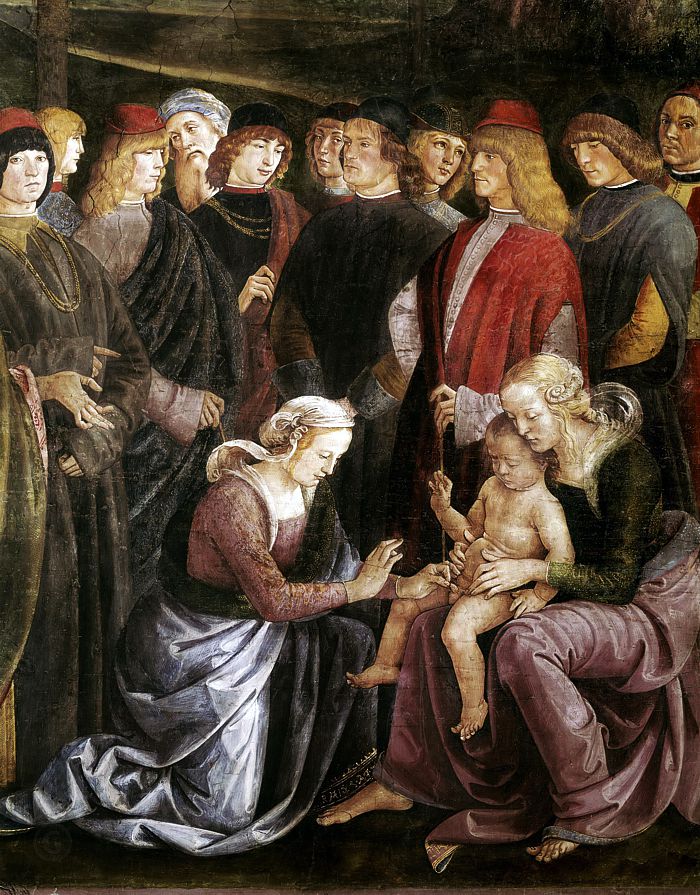
In 1481 came the opportunity that would change his destiny. Pope Sixtus IV, who had just built a new chapel in the Vatican, wanted to decorate it with the best painters in Italy. He gathered a dream team: Botticelli, Ghirlandaio, Cosimo Rosselli, Luca Signorelli. And among them, Perugino.
The chapel bore the pope's name and did not yet have the ceiling that would make it universal. Its side walls were to tell two parallel stories, that of Moses and that of Christ, as if the Old and New Testaments were facing each other. Perugino was given several scenes, and one of them would become his most famous work: the Delivery of the Keys to Saint Peter.
Look at it slowly. Christ hands the keys of the kingdom of heaven to Peter, before a group of apostles arranged on both sides as in a slow choreography. But the extraordinary part is not the figures, it is what lies behind them. An immense, perfectly paved square stretches into the distance with an almost mathematical geometry. At its center, a circular temple. On either side, two triumphal arches. And at the back, a clean horizon where the hills dissolve into blue.
It is a painting that does not shout. It is built with order, with silence and with a precision that seems to breathe. And it worked. By the time he finished his work in Rome, Perugino was already one of the most important names in Italy.
The Most Sought-After Painter
What followed were years of success. Commissions poured in from everywhere: churches, monasteries, confraternities, powerful families. Perugino ran busy workshops in Florence and Perugia, and his output grew at a pace few could match.
Among his most admired works is the decoration of the Collegio del Cambio in Perugia, the hall where the city's bankers and merchants met. Between the late fifteenth century and the year 1500 he painted there a set of frescoes in which figures from mythology and classical history live alongside Christian scenes, all under the same serene light. It is considered one of his great achievements.
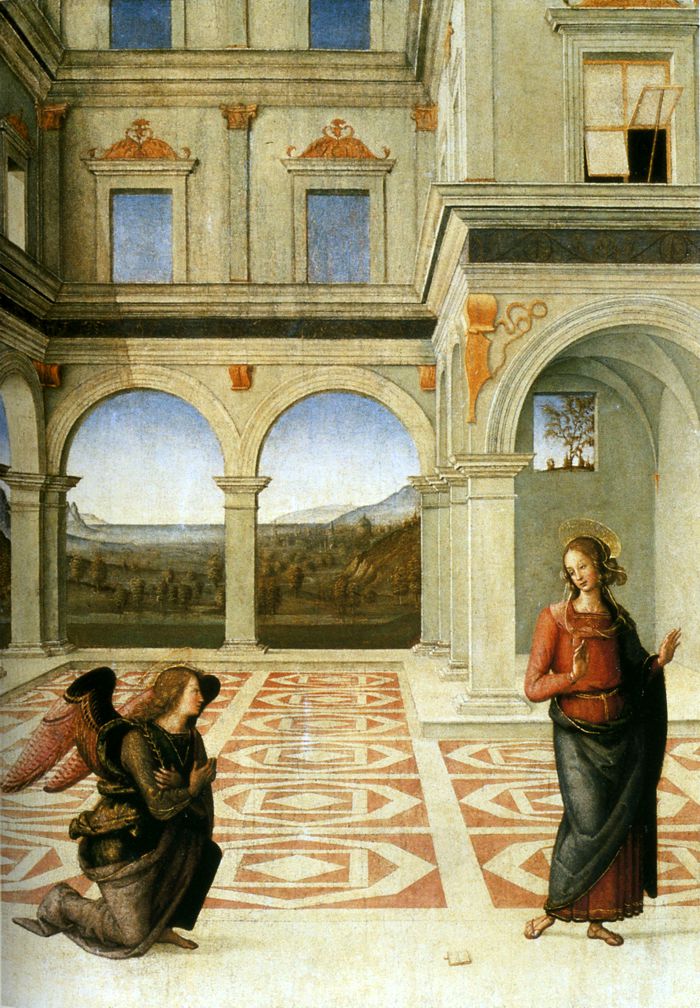
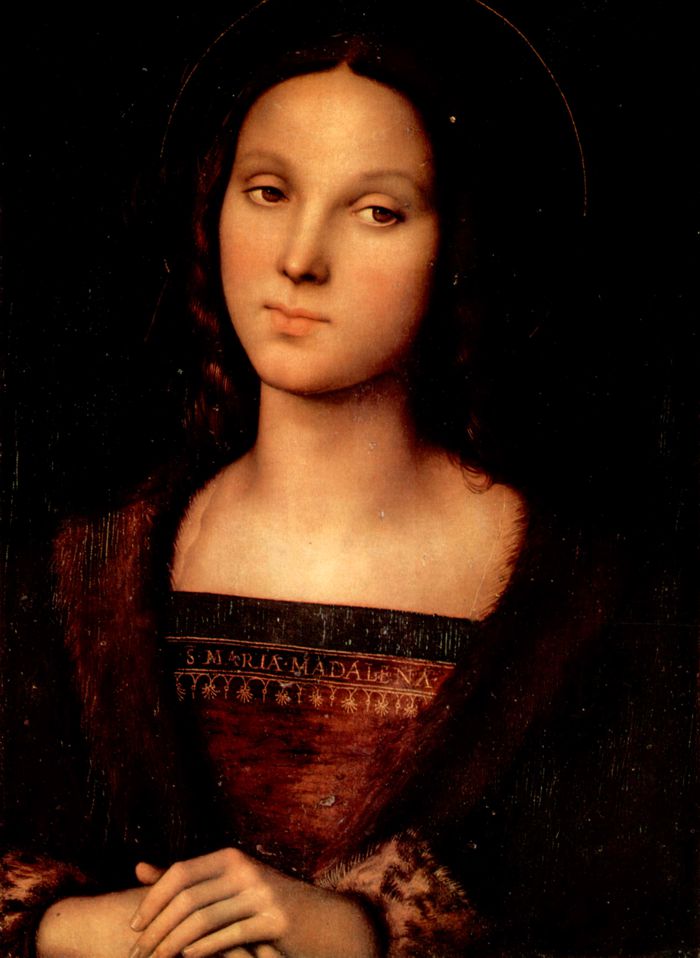
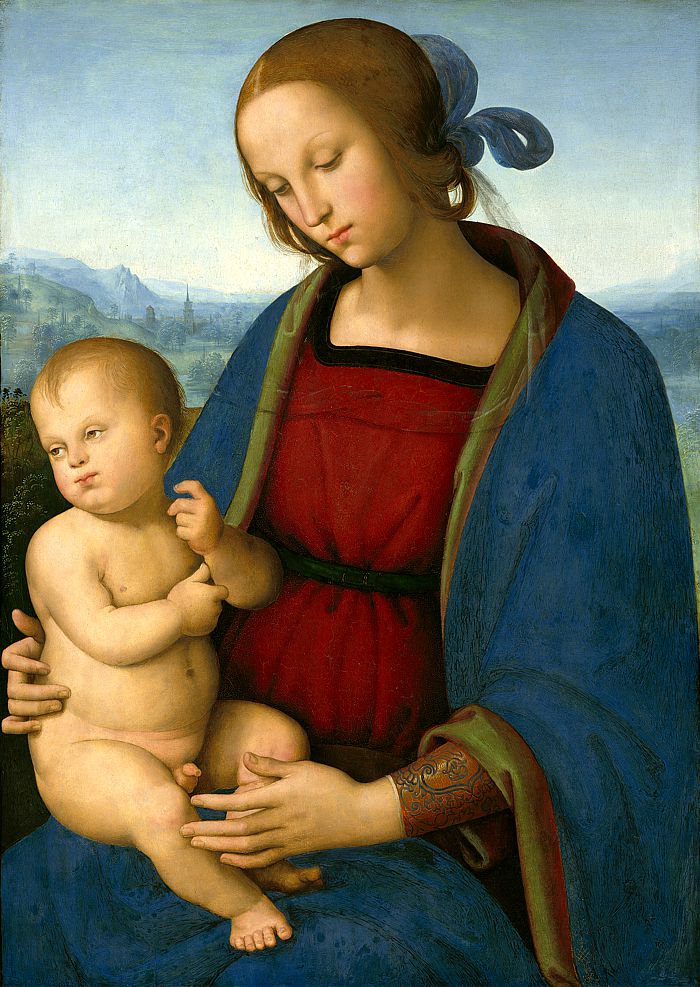
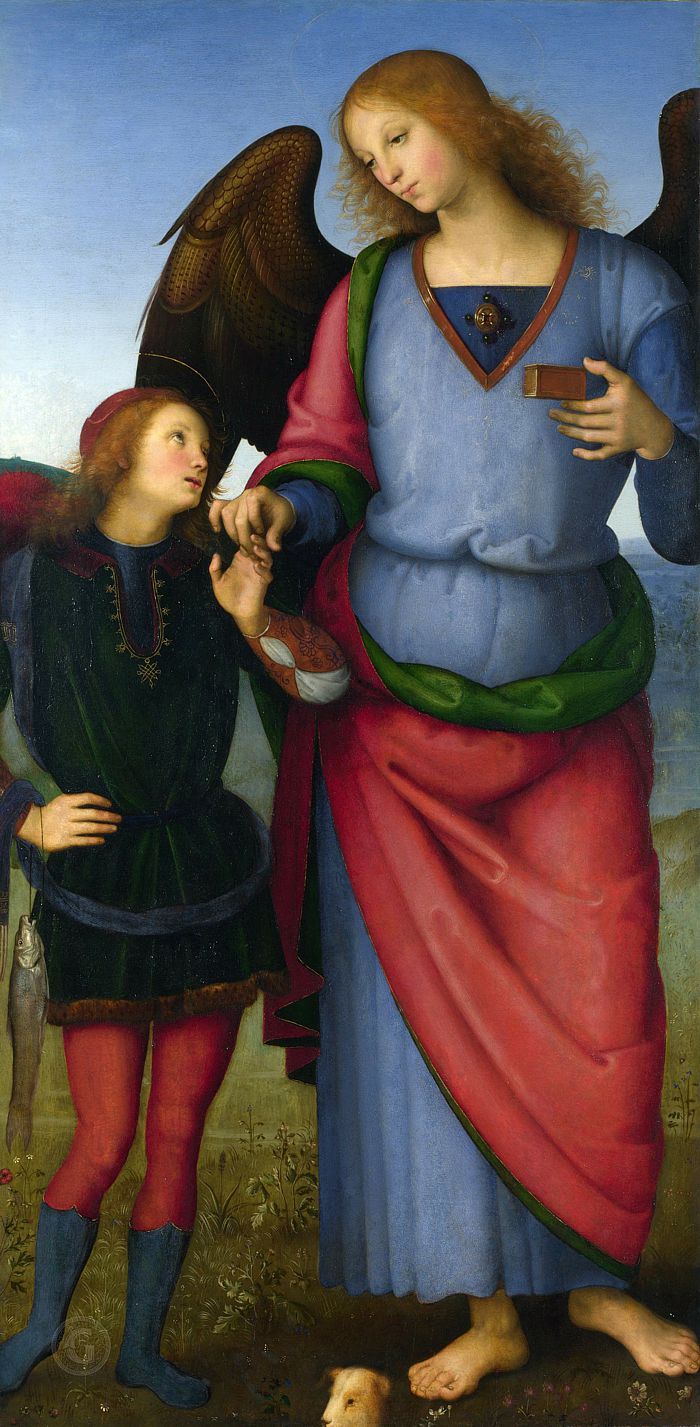
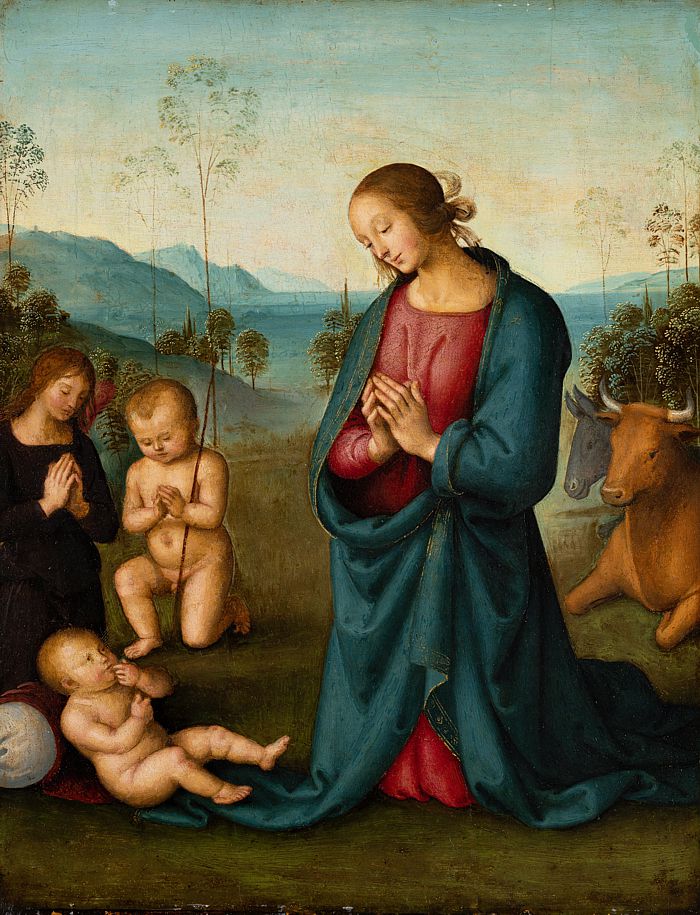
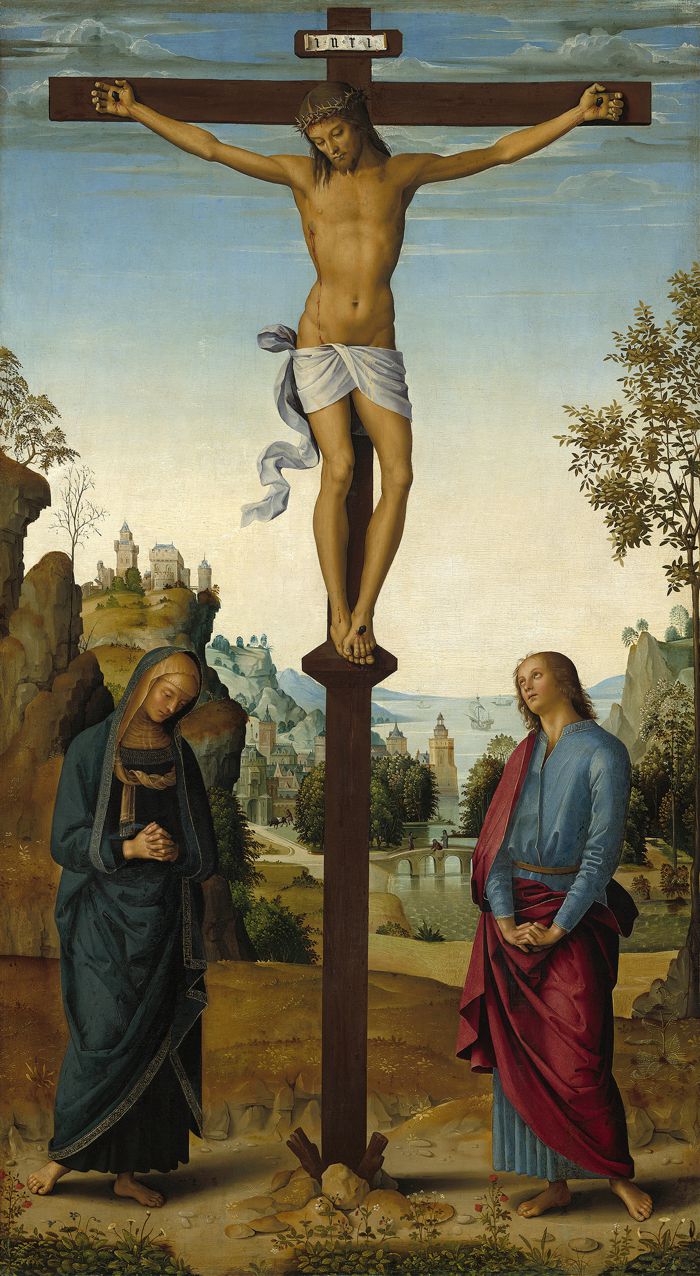
His style became unmistakable. Slender figures with restrained gestures. Faces that tilt slightly, with an almost musical sweetness. Wide landscapes, thin trees and distances that invite you to get lost. Deep colors, but never violent ones. Before a Perugino, you do not feel astonishment: you feel calm.
For many worshippers of his time, that was exactly what they wanted. A painting that did not distract, that did not impress with drama, but helped them pray.
The Young Man from Urbino
While Perugino consolidated his fame, a boy named Raphael Sanzio was growing up in Urbino. He was born in 1483, the son of a painter, and moved among brushes and pigments from an early age. His father died when Raphael was only eleven years old.
Tradition names Perugino as his teacher, and the influence is impossible to ignore. One only has to look at Raphael's early works to recognize the air of Umbria: the gentle figures, the orderly composition, the luminous landscapes. The young man had found in Perugino a model, and he studied him with fierce attention.
There is a comparison that art historians repeat again and again. Perugino painted a scene called the Marriage of the Virgin, with a temple in the background and the figures lined up at the front. A few years later, Raphael painted his own version of the same subject, dated 1504. The structure is almost identical. But Raphael did something different: he gave the space more air, the figures more movement, the temple a rounder and more harmonious shape. Where Perugino arranged, Raphael made things breathe.
It is one of the most fascinating moments in the history of art. There is no betrayal or scandal, only a student who takes what he has learned and carries it one step further. For Perugino, looking at that painting must have been a strange experience: the pride of seeing his style become a foundation, and the certainty that someone younger was surpassing him.
When Taste Changed
At the beginning of the sixteenth century, Italian art began to transform. Leonardo explored movement and atmosphere. Michelangelo sculpted tense bodies full of force. Raphael, already out of his teacher's shadow, opened up a new idea of beauty, more dynamic and more complex.
Against that backdrop, Perugino's calm began to seem, to some, too still. He was reproached for repeating formulas and reusing figures from one painting to another. What had once been his trademark began to read as a limit.
It was not a sudden fall or a scandal. It was something slower and more painful: the silent change of taste. The world that had celebrated his serenity now sought other emotions. Perugino kept painting for years, with active workshops and commissions, but he was no longer at the center of the conversation. He often returned to Umbria, to that land of gentle hills he never stopped painting.
The Wall That Vanished
Then came the most symbolic episode of his story. Decades after Perugino finished his work in the Sistine Chapel, Michelangelo was commissioned to paint the Last Judgment on the altar wall. It was a monumental project, an apocalyptic vision of bodies suspended between salvation and damnation.
But that wall was not empty. Perugino and other artists had painted their own scenes there, including an Assumption of the Virgin that presided over the altar. To make room for the Last Judgment, those frescoes were destroyed.
Here lies the deepest irony of this whole story. One of Perugino's most important works was covered by the work of an artist who represented exactly the opposite: strength, tension, drama. The painter of calm was buried beneath the painter of the storm.
Still, not everything was lost. In that same chapel the Delivery of the Keys survives, and on its side walls you can still see his Baptism of Christ. Those who look up at the ceiling usually miss them. But they are still there, waiting for whoever lowers their gaze.
The End in Fontignano
Perugino died in 1523, in Fontignano, a small town near Perugia, a victim of the plague. He was over seventy years old. He had been born in an Umbrian village, had passed through Florence and Rome, had worked alongside the greatest names of his time and had watched the world that applauded him drift slowly toward other tastes.
It is a modest end for someone who was once so celebrated. But perhaps it fits the way he painted: without noise, without drama, with a quiet dignity.
What Remained
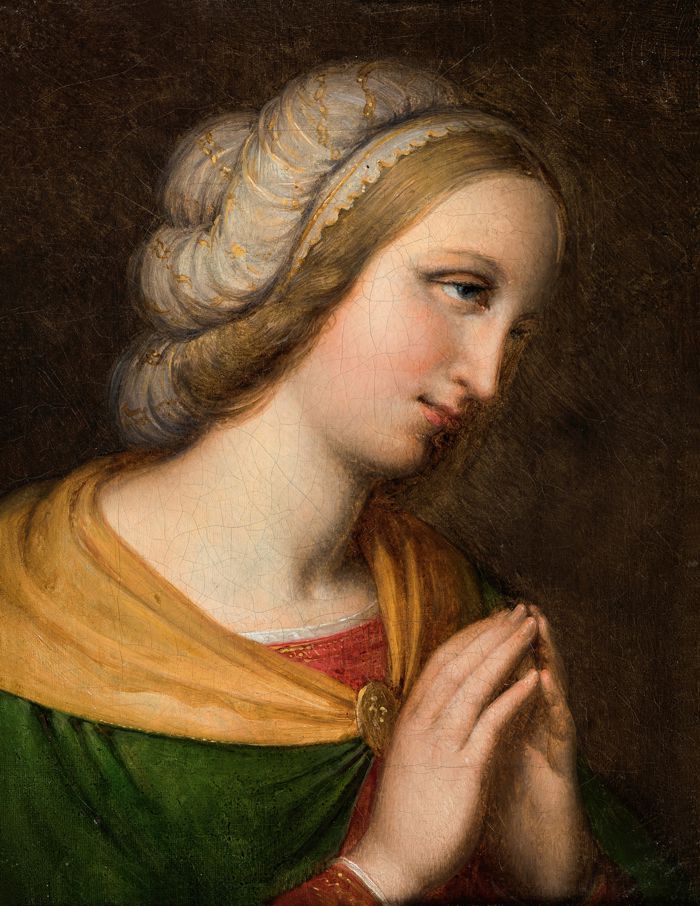
Today, when we talk about the Renaissance, the names we all know come first: Leonardo, Michelangelo, Raphael. Perugino stands to one side, almost like a footnote. And yet, without him the story would be incomplete.
Perugino taught us to see space as a place where figures can breathe. He helped build that ideal of harmony and balance that Raphael would take to its fullest expression. And he left behind a collection of images that still hold a strange power today: they do not dazzle, but they calm.
Among so much painting that seeks to impress, his offers something rarer. A clear sky, a road that fades into the distance, a gaze that lowers gently. An invitation to stay a moment longer.
Perhaps that is why Perugino is still waiting, five centuries later. Not to be discovered with a roar, but for someone, in a crowded room, to stop in front of one of his paintings and, without quite knowing why, lower their voice.