

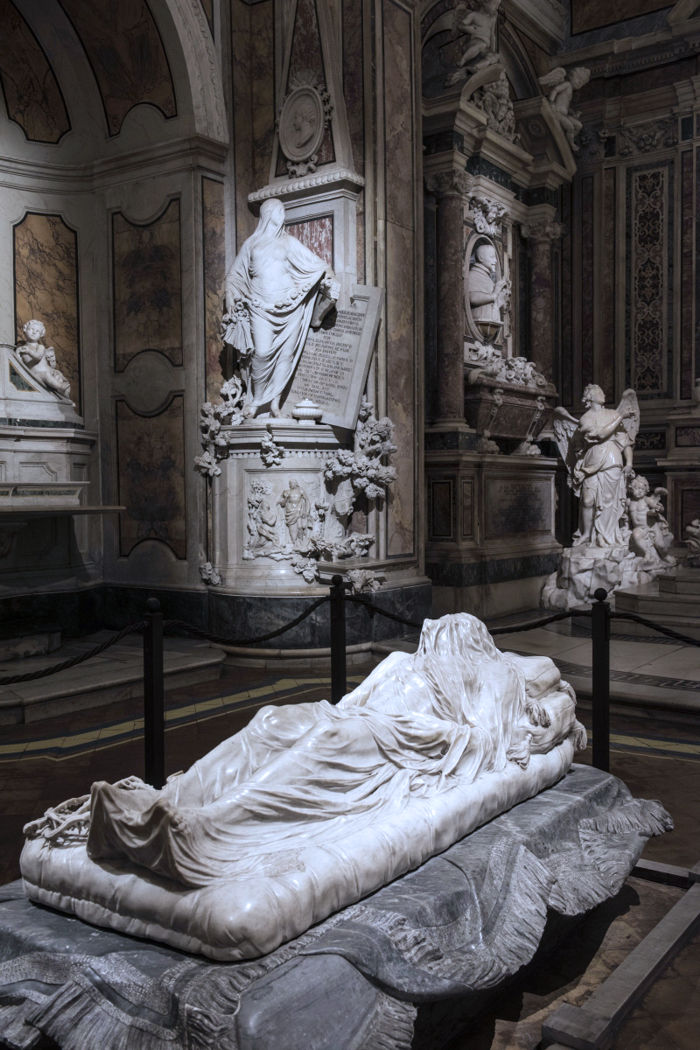
Imagine you walk into a small chapel in the heart of Naples. Outside, the city is noise: narrow alleys, voices bouncing off the walls, laundry hanging from balcony to balcony. Inside, suddenly, silence. You walk slowly and, in the center of the nave, you see a body lying down, covered by a shroud.
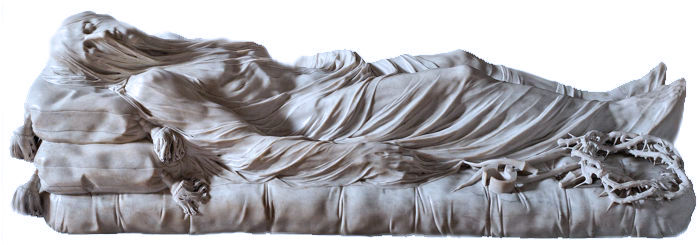
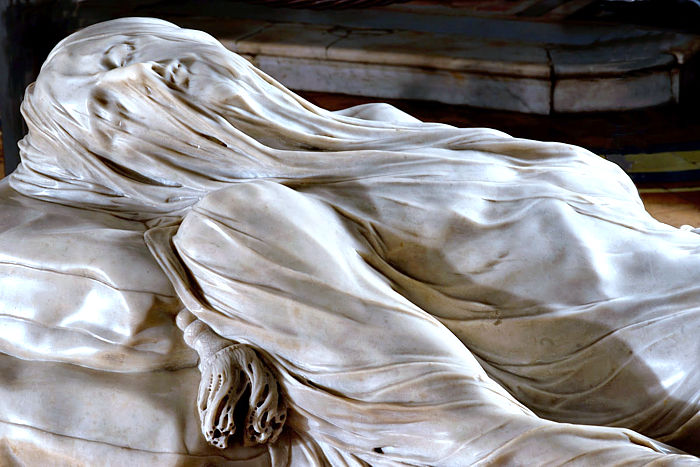
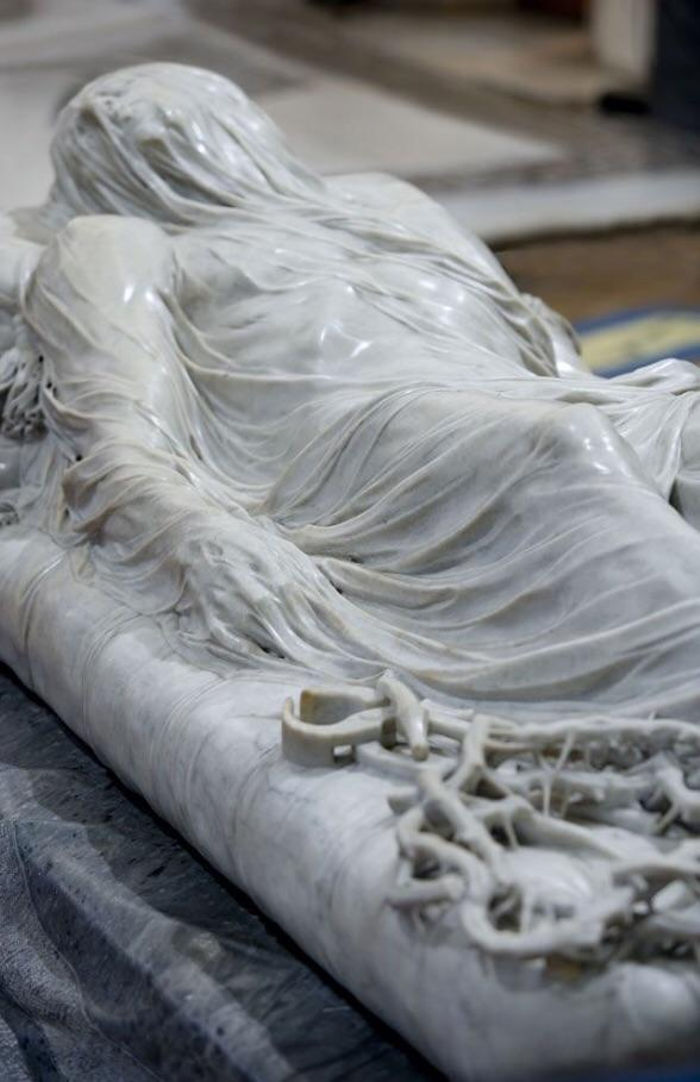
You step a little closer and something doesn't add up. The cloth clings to the chest as if it were wet. It marks the ribs, the knees, the feet. Beneath that sheer veil you can make out the veins of the legs, the closed eyelids, the barely parted lips. Your mind is perfectly sure: that is fabric.
But it isn't. It's marble. A single block, with no additions, no glue, no tricks. It is called The Veiled Christ, it was carved by Giuseppe Sanmartino in 1753, and ever since, everyone who sees it does exactly what you just did: they refuse to believe it.
For centuries it was said in Naples that the veil had once been real fabric, turned to stone through an alchemical secret. And that story was not invented by naive tourists. It was allowed to grow by the man who paid for the work.
The Prince Who Wanted a Message
His name was Raimondo di Sangro and he was the seventh Prince of Sansevero. Born in 1710, he lost his mother when he was barely a year old, so he grew up among books, tutors and a curiosity unlike anyone else's around him. He was a soldier, a writer and an inventor. He is credited with colored fireworks that no one managed to copy, waterproof fabrics, inks that never faded, and even an amphibious carriage drawn by cork horses that supposedly sailed over the waters of the Bay of Naples.
In the basements of his palace he kept a laboratory where he experimented with chemistry and with substances almost no one in the city understood. According to tradition, he was also grand master of Neapolitan Freemasonry, and in 1751 the Church excommunicated him. A man like that did not think of his family's chapel as a place to pray. He thought of it as a message: a space where art, science and symbols would tell a story that only the initiated could read.
And for the center of that message he wanted an impossible image: a dead Christ, covered by a transparent veil, carved from the same block of marble as the body.
One Commission, Two Sculptors
The first choice was Antonio Corradini, a Venetian sculptor famous for his veiled figures. A work of his still stands in that same chapel: a woman covered by a marble veil that lets her whole body be glimpsed, the Pudicizia (Modesty). But Corradini died in 1752, and all he left for the Christ was a small terracotta sketch.
Then the prince turned to a Neapolitan sculptor, Giuseppe Sanmartino. The contract left no room for doubt: a life-size marble statue representing Our Lord Jesus Christ dead, covered by a transparent shroud carved from the same block as the figure. The price was five hundred ducats, and on December 16, 1752 the Banco di Napoli recorded the advance of fifty.
What happened next, nobody expected. According to the chapel's own museum, Sanmartino paid very little attention to Corradini's sketch. He set the master's plan aside and began from scratch. Corradini had carved elegant, delicate, almost theatrical veils. Sanmartino imagined something else: a shroud that does not float or adorn, but clings to an exhausted body, the way soaked clothing sticks. A cloth that, instead of hiding suffering, draws it. Every muscle, every wound, every vein.
Meanwhile, the prince oversaw every detail with drawings, instructions and letters, so that nothing would alter his message. By 1753 the sculpture was finished.
Beneath the Chapel
There is a staircase that descends toward the crypt. There, in two display cases, are two human skeletons, a man and a woman, and over their bones, spread like a net of reddish threads, the complete figure of their circulatory system: arteries, veins, capillaries, all in three dimensions. They are known as the anatomical machines, and for centuries a terrifying story was whispered in Naples: that Raimondo had injected an alchemical substance into the veins of two of his servants, still alive, to petrify their blood before they died.
Modern analyses tell a different story. Those networks are not petrified veins but an artificial construction of wax, silk and wire mounted on real bones. Even so, one detail says a lot about the prince: he never made an effort to deny the legend. He preferred people to believe he was capable of the supernatural. And with the Veiled Christ he did exactly the same.
In his letters he spoke of the veil in deliberately ambiguous language and mentioned processes and secrets shared with the sculptor. He never said he had turned fabric into stone, but he never denied it either. He let doubt work for him.
The documents, however, are clear. In the payment order signed by Raimondo himself, the work appears as the statue of Our Lord dead, covered with a veil likewise of marble. And in a letter to the French physicist Jean-Antoine Nollet he described that veil as part of the same block as the figure. There was no alchemy and no petrification. There was a man with a chisel, a block of stone and a patience that is still hard to imagine today.
The Symbolism of the Veil
So, if the veil is not an alchemical trick, what is it? Perhaps the best answer lies in the paradox it holds. In the Christian tradition, covering a dead body is a gesture of piety: one covers to protect the dignity of the deceased and hide his pain. Here the opposite happens. The veil does not hide Christ; it exposes him. It makes every wound more visible, every rib more defined, every trace of suffering more legible than if the body were naked.
The convulsed folds that Sanmartino gave the cloth, late Baroque in spirit, do not console: they underline. The fabric that should hide the pain amplifies it, which is why the sculpture is usually read as an image of the suffering of Christ and, with him, of all humanity.
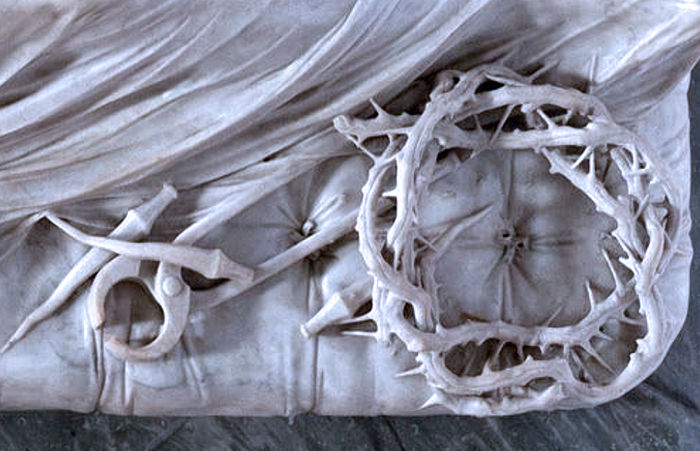
The other elements reinforce that reading. Christ lies on a bed, his head resting between two pillows, and at his feet are the instruments of the Passion: the crown of thorns, the pincers and the nails that took him down from the cross. They are small objects, carved with astonishing minuteness, that recall what happened before the silence.
The veil, moreover, is not the only one in the chapel. The theme recurs in other sculptures, and each one holds a story tied to the prince's family. Corradini's Pudicizia is dedicated to Cecilia Gaetani, the mother Raimondo barely got to know; beside the veiled figure there is a broken tombstone, alluding to a life cut short too soon. And Francesco Queirolo's Disinganno (Disillusion), dedicated to his father, Antonio di Sangro, shows a man caught in a net of marble that alludes to the vices and passions in which human beings become entangled in earthly life, until final disillusionment. Beside him, a young genius with a flame above his head symbolizes the intellect that guides him toward truth. It is another kind of veil: one that does not cover, but imprisons.
Some scholars also propose a Masonic reading of the Veiled Christ, noting that the original project envisioned placing it in the crypt, a space that has been interpreted as a place of initiation. It is an interpretation and not a documented intention, but it fits the prince's way of thinking: a work with layers, designed for those who knew how to read them.
The Sculptor Almost No One Remembers
It is said that, decades later, Antonio Canova, the most admired sculptor of his time, stopped in front of this work and said he would give ten years of his life to have created it. It is an anecdote of tradition, not a documented fact, but it says a lot about the fame the Christ achieved.
And yet the man who carved it is remembered by almost no one. Everyone knows Michelangelo, Bernini, Canova. Giuseppe Sanmartino was reduced to a name on a museum plaque. Perhaps because his work was so perfect that people preferred to believe in alchemy rather than accept that human hands could make something like this.
Documents or Eyes?
The Veiled Christ still stands where the prince placed it, at the center of the Sansevero Chapel, and everyone who stops before it ends up facing the same question. Do you trust the documents, which say it is marble? Or do you trust your eyes, which tell you it is impossible?
Perhaps the answer is that both are right. The veil is stone, but your gaze turns it into fabric, and that distance between what you know and what you see is, perhaps, the true secret Raimondo di Sangro wanted to keep in his chapel.
THE ARTWORK
Veiled Christ
Author Giuseppe Sanmartino (Antonio Corradini - sketch)
Created 1753
Location Sansevero Chapel
Naples, Italy