

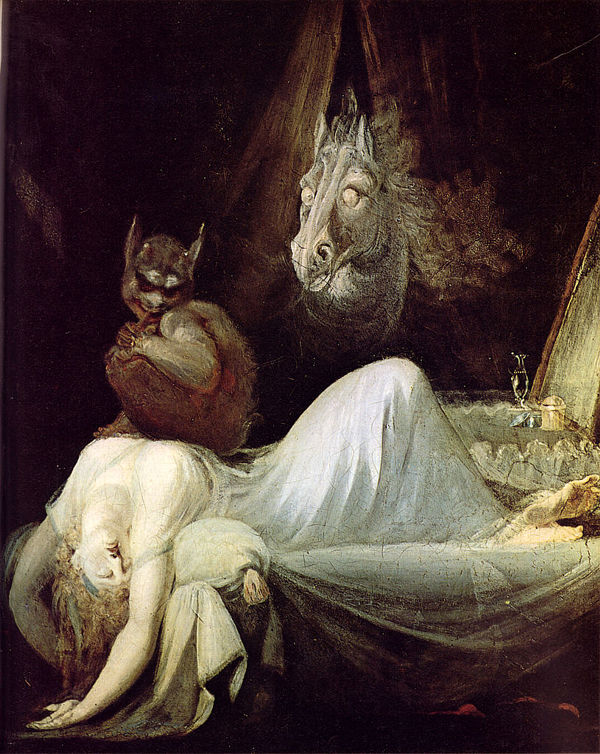
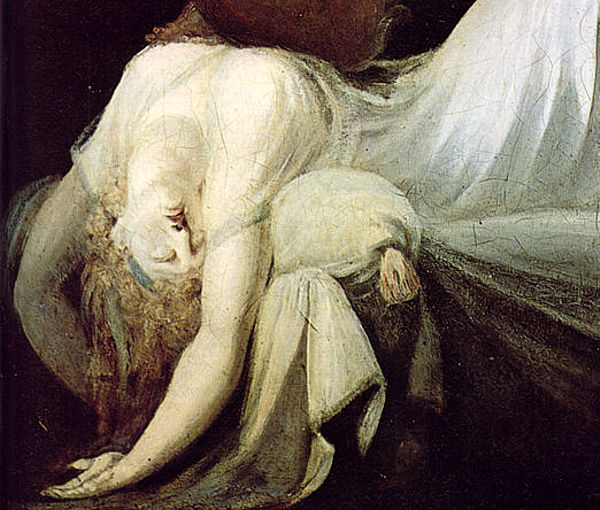
This woman is not dreaming. She is being crushed. Look closely. She hangs off the bed, her head thrown back and her arms limp, as if her body no longer belonged to her. On her chest sits a small, heavy, motionless creature. And it is staring at you. At you. Throughout history, dreams have been read in many ways. The ancient Egyptians believed they were messages from the gods.
At the end of the 19th century, Sigmund Freud turned them into the voice of the unconscious mind's fears and desires. But dreams are not always kind, and there is one that nobody wants to have: the nightmare.
In 1782, a Swiss painter named Johann Heinrich Füssli, who signed himself Henry Fuseli in England, hung his canvas in the annual exhibition of the Royal Academy in London. And the public did something almost no one did in front of a painting: they shuddered. In an age of portraits, battles and sacred scenes, The Nightmare does not tell an event or show a person. It paints a concept, a fear. And that fear has a name: the incubus.
The Incubus: A Demon with a Theological Treatise
The word comes from Latin and means "to lie upon." A demon who visits sleeping women at night with a single purpose. And this was no peasant superstition: it was theology.
Saint Augustine already wrote about these spirits in The City of God. Centuries later, Saint Thomas Aquinas, one of the most brilliant minds of the Middle Ages, asked in all seriousness how a demon, which has no body, could unite with a woman. His answer is chilling: the demon creates nothing, it steals. As a succubus, it takes a man's seed. As an incubus, it carries it to a woman. Two faces of the same demon.
In 1486 came the Malleus Maleficarum, the manual that taught Europe how to hunt witches. It devotes entire pages to incubi and lists five remedies against them: confession, the sign of the cross, exorcism, excommunication of the demon... and moving house. Yes, running away from your own home.
From this belief also came the most famous legend of all. According to the chronicle of Geoffrey of Monmouth, in the 12th century, the wizard Merlin was the son of an incubus.
The Stories Told in the Dark
Stories of incubi were countless, and some are truly sinister. It is said that in the region of Nantes lived a woman tormented by a demon. It came at night, while her husband slept beside her, suspecting nothing. For six years she kept the secret, alone, ashamed and afraid. In the seventh year she confessed to the priests. She made pilgrimages. She prayed. Nothing worked: the demon returned every night, bolder each time. Until the secret came out, and her husband exploded with rage.
Then Saint Bernard arrived. He entrusted the woman with his pilgrim's staff and, on Sunday, before preaching, ordered everyone present to light a candle. He pronounced an anathema against the spirit and forbade it to approach that woman or any other. When the candles went out, the story says, the demon's power went out with them. The woman confessed, took communion, and the enemy never returned.
Another story tells of Magdalena de la Cruz, abbess of Córdoba, who according to tradition had an incubus with goat's legs as her lover. Magdalena was real: for decades she was venerated as a living saint, until the Inquisition tried her in 1546 and she confessed to having made a pact with demons. That is documented.
An important warning: the tale of the woman of Nantes is attributed to a monk named Ernauld, and there is no reliable source to confirm it. The same goes for the detail of the lover with goat's legs: Magdalena's trial is real, but that incubus belongs to the tradition told afterward, not to anything we can prove. We include them because they are part of how fear was told in their time, but they are not proven facts.
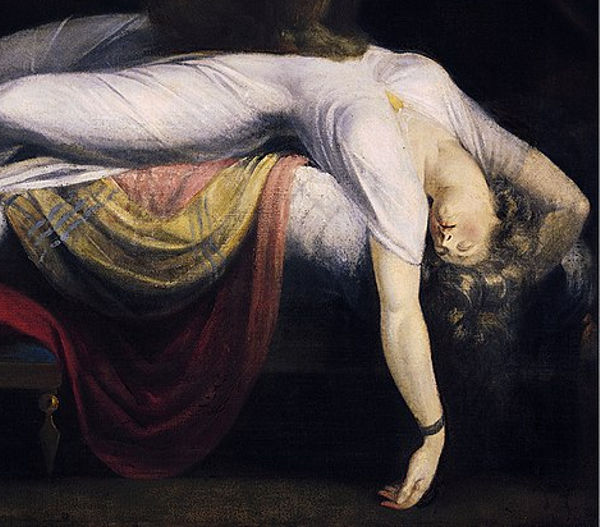
What is real is what believing them meant. If a medieval woman woke up crushed, breathless, sensing a presence in the room, nobody told her she'd had a nightmare: they told her a demon had entered her bed. And if an impossible pregnancy appeared, the culprit was already chosen: not the man, not her. The incubus. A very convenient demon.
The Science Behind the Weight on Your Chest
Today science calls it sleep paralysis: you wake up, you cannot move, you feel pressure on your chest and the certainty that someone is watching you. It is the brain, caught between sleep and waking. Before that explanation existed, terror needed a face. And Fuseli gave it one.
Some interpreters see in the incubus on the sleeper's chest exactly that: the physical effect of nightmares, the oppression felt during sleep.
The Mare, the Light and the Shadow
Notice how the scene is built. Light falls on the woman, white, almost ritual. Everything else is blackness. That brutal contrast comes from a long tradition of chiaroscuro and from Michelangelo, whom Fuseli studied for years in Rome. Many have read it as an image of the divided mind: what we see and what we refuse to see, the unconscious lurking in the shadows.