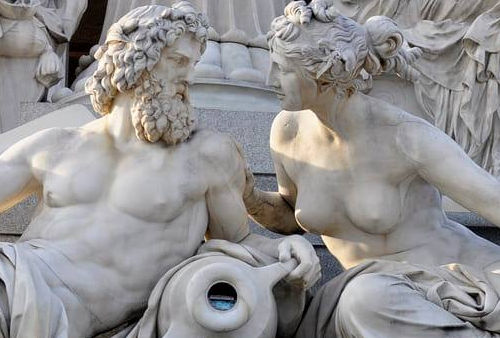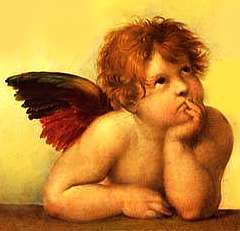


Before the first ray of sunlight touches the valleys, the peaks keep secrets that mortals rarely get to witness. To the ancient Greeks, mountains were never empty places: they could also be home to spirits of nature, eternally beautiful young women who embodied the wild beauty of the earth. They were the nymphs.
According to Greek mythology, nymphs were nature spirits who embodied the beauty and vitality of the natural world: young, eternally beautiful, in the full bloom of their femininity. These figures didn't remain confined to myth — in the 19th century they found a prominent place in art, when painters like William-Adolphe Bouguereau began depicting them as symbols of sensuality and the mystery of the wild, often centering their gaze on the nymphs' nudity and their link to the forbidden.
Who the nymphs were, and where the word comes from
The word nymph comes from the Greek term for "bride" or "veiled one," a root that directly ties them to youth and fertility. In legend, these beings are described as protectors of specific places: streams, forests, mountains, and fields. Some were kind and helped mortals; others were elusive and reserved. Mythology sorts them into several groups: the Naiads, nymphs of freshwater bodies; the Dryads and Hamadryads, spirits of trees and forests; the Oceanids, guardians of the sea; and the Oreads, who inhabited mountains and valleys.
Each group had a special connection to its environment, which granted them particular powers. The Dryads, for instance, were believed to die if the tree they were bound to was destroyed. The Naiads, guardians of rivers and springs, carried a reputation for healing and prophecy, especially at sacred springs where many came seeking divine help. Nymphaea — sanctuaries dedicated to nymphs in grottoes, springs, or groves — were spaces where rituals were held in their honor.
The Oreads, nymphs of the mountains
The Oreads were the nymphs of the mountains, and their depiction in art is one of the most enigmatic subjects in mythology. They were believed to inhabit peaks, valleys, and cliffs. They belonged not to palaces or cities, but to the wild nature of the heights, and they formed part of the retinue of Artemis (Diana to the Romans), goddess of the hunt and protector of forests and wildlife. According to tradition, at her signal they would set out in swift, joyful bands to join her in pursuing deer and wild boar, and to hunt birds of prey with their arrows.
Among all the Oreads, legend remembers one above all: Echo.
The myth of Echo: the voice trapped in the mountains
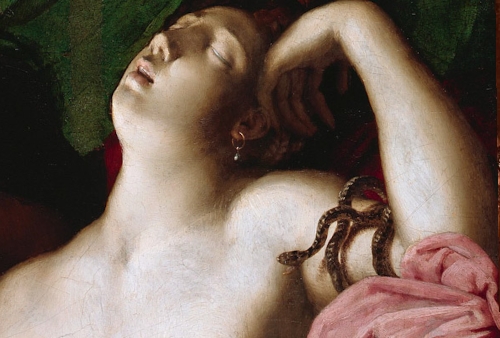
The most widespread version of the myth, the one recorded by Ovid, tells that Echo kept Hera entertained in conversation while Zeus met with other nymphs. When Hera discovered the deception, she punished Echo: from then on, Echo could only repeat the last words she heard, unable to speak her own thoughts.
Later, Echo fell in love with Narcissus. Unrequited, she wasted away until nothing remained of her but her voice. And when someone hears an echo in the mountains, it's as if that voice still answers from the rocks.
There is also another, lesser-known tradition that links Echo to the god Pan. In this version, Echo rejects Pan, and he, spurned, drives a group of shepherds mad; they tear her apart, and the earth hides the fragments of her body, which retain the ability to repeat any sound. Both versions agree on the essential point: Echo loses her body and her own voice, condemned forever to repeat the words of others.
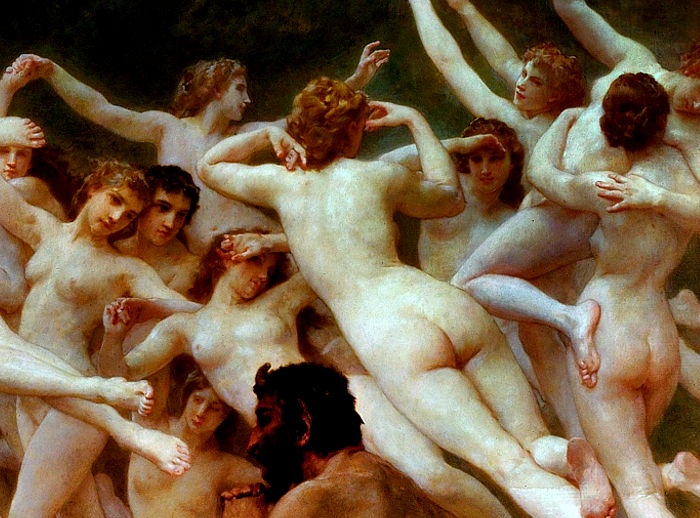
Bouguereau's The Oreads
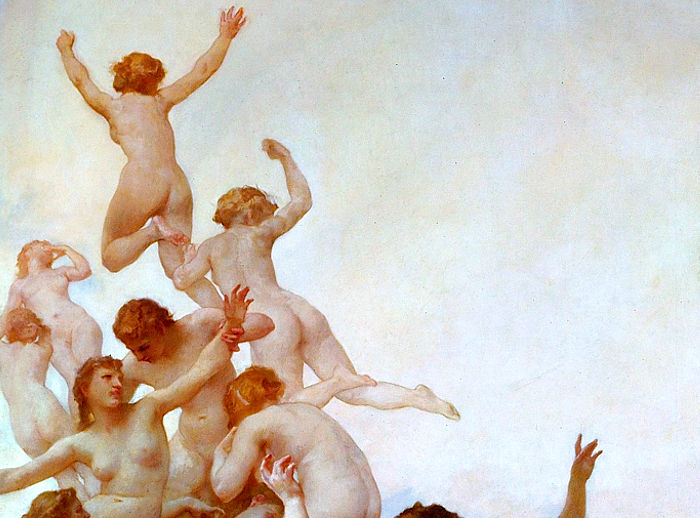
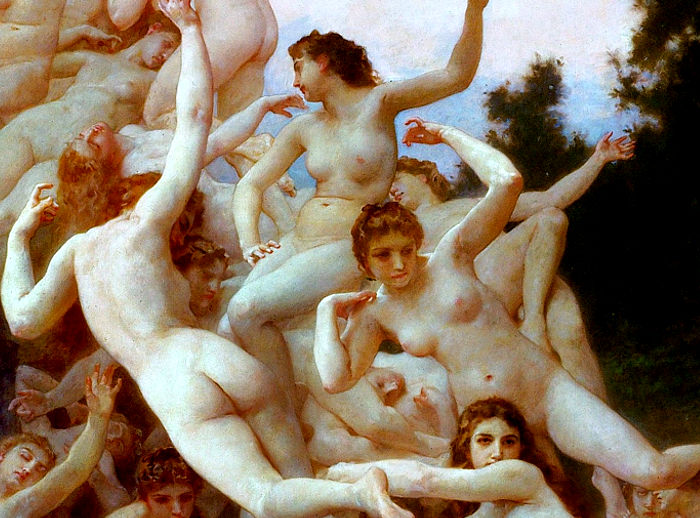
In The Oreads, Bouguereau depicts a procession of nymphs rising into the air toward the mountains, at the very instant night surrenders to the first light. As morning arrives, they leave the shadows of the earth behind to join in a weightless dance, rising toward the sky like a prayer to the newborn sun.
Below, in the dim light of the forest, the satyrs' procession comes to a halt. Creatures of nature and instinct, they watch in astonishment as the celestial vision ascends above their heads. It's the meeting of two natures: the earthly, bound to the ground, and the ethereal, seeking the freedom of the heights. Even for the mythical beings of the forest, the nymphs' awakening is a sight that can only be witnessed in silence.
The work captures the mystery and charm of these mythical beings, as if, after a night of play and dance on earth, they were returning to the ethereal world they inhabit. The figures are wrapped in a soft light evoking dawn, as the nymphs seem to float upward, watched by curious fauns.
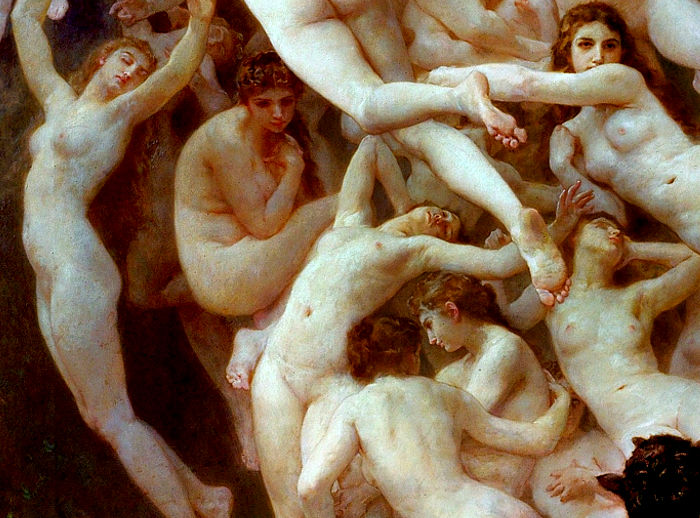
Fair and dark skin: the symbolism of contrast
In many works of mythological art, especially those of the Renaissance and Neoclassicism, satyrs are shown with dark skin in contrast to the fair skin of the nymphs, and that contrast carries an interesting symbolic reading.
Satyrs were creatures associated with wildness, unrestrained nature, and primal instinct, while nymphs were linked to purity, beauty, and the ethereal. This difference in tone helped visualize that contrast: the satyrs' dark skin evoked the primitive and chaotic, while the nymphs' fair skin evoked the divine and the idealized. In many depictions, satyrs are also shown chasing nymphs, personifying unchecked desire against an elusive beauty, a visual tension that underscores the idea of a forbidden or distant longing. With the Christian reinterpretation of these myths during the Renaissance, the satyrs' dark tones became associated with "sinful" traits, while the nymphs' fair tones reinforced an "untouchable" beauty and purer virtues.
The viewer's gaze
The satyrs' glances are not innocent. Bouguereau deliberately introduces an erotic dimension: they remain below, watching the nymphs' naked bodies rise toward the sky. And when we look at the painting in a museum, we too are below, looking up at them. For an instant, the viewer occupies almost the same place as the satyrs.
That sensuality is presented subtly yet enveloping, recalling the idealized vision that academic art of the late 19th and early 20th centuries held of these mythological figures. With great mastery, Bouguereau manages not only to depict the female figure, but also to capture the spirit of an era fascinated by the mythological, the sensual, and the sublime in nature.
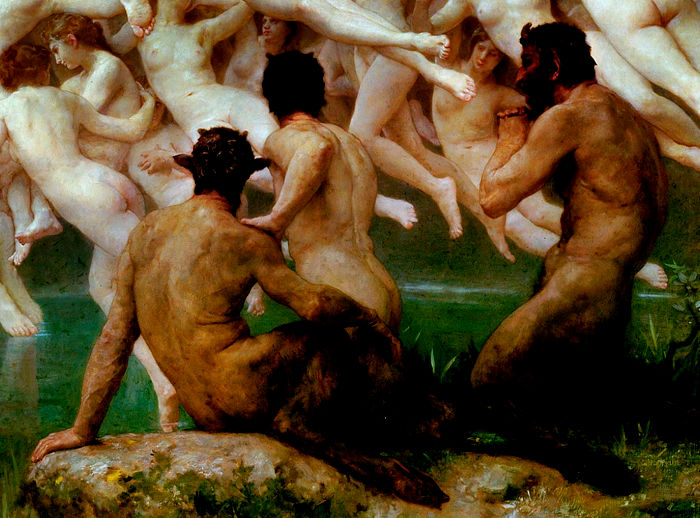
Curious facts about the painting
Bouguereau painted The Oreads in 1902, at 77 years old, just three years before his death. It is one of his last major compositions and, without doubt, one of the most ambitious of his entire career: on a canvas over two meters tall, he arranged a multitude of female figures in mid-flight — informal counts put the number at close to forty — watched over by only three satyrs from the riverbank. Sustaining a composition of this scale and complexity at that age astonished even his contemporaries.
The painting also had an unusual history once finished: rather than being sold or exhibited right away, it remained in the Bouguereau family's possession for over a century, largely out of public view. It wasn't until 2009 that his descendants handed it over to the French state as partial payment of inheritance taxes, through a legal mechanism called a dation, and it entered the collection of the Musée d'Orsay, with its acquisition formalized in 2010.
The mountains hold stories that time hasn't been able to erase: whispers of a world where the sacred dwelled in every corner of nature.
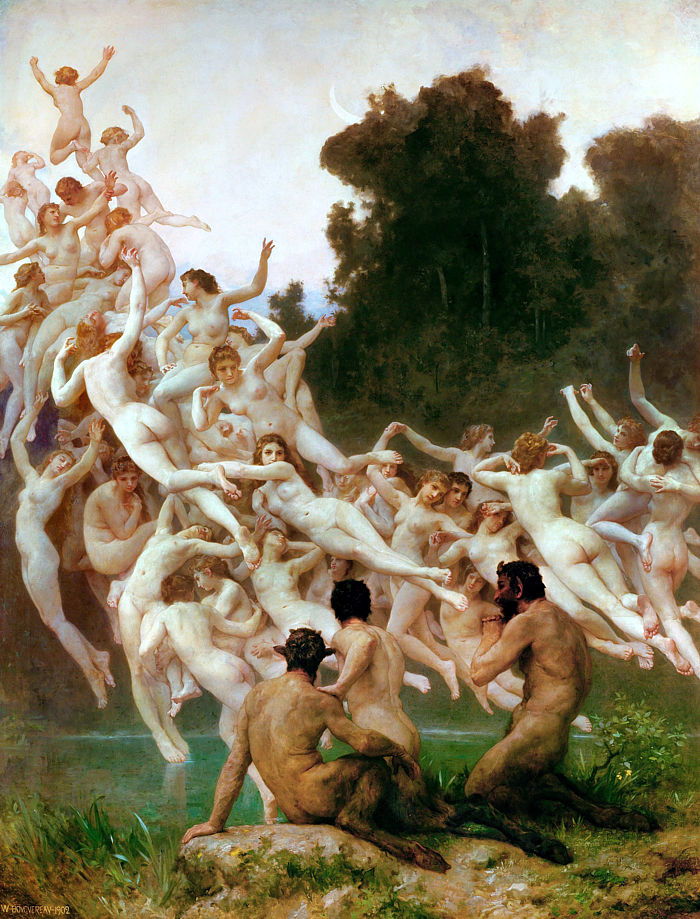
THE ARTWORK
The Oreads
William-Adolphe Bouguereau
1902
Oil on canvas
Dimensions 236 x 182 cm
Location Musée d'Orsay (France)