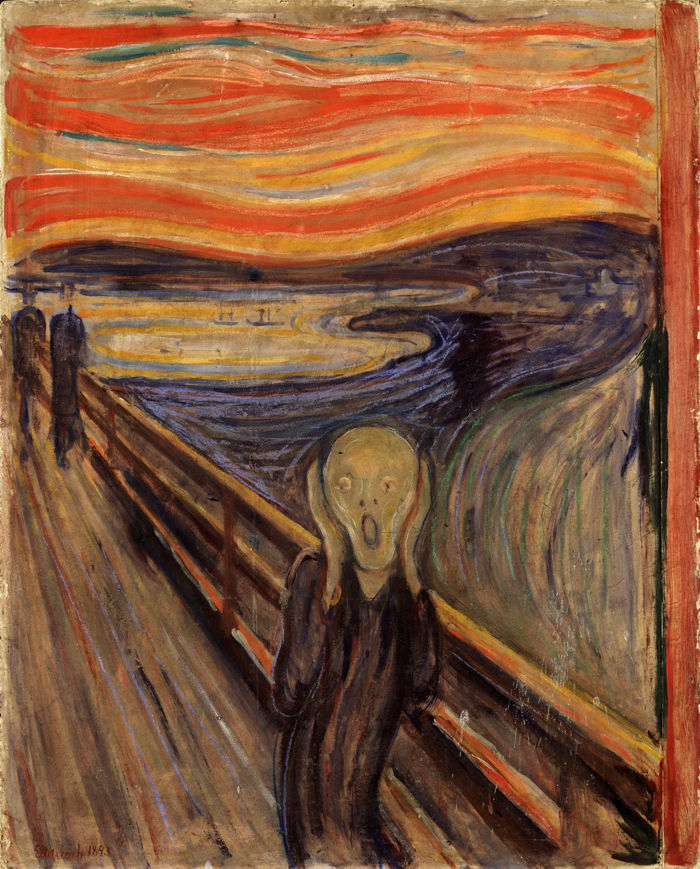


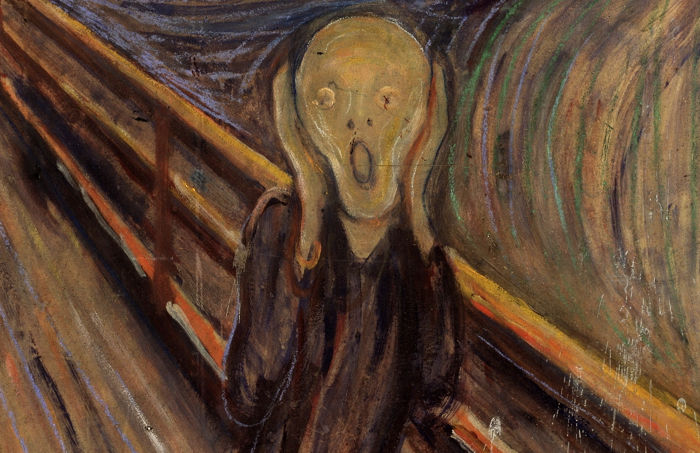
Some images become permanently etched into humanity's collective memory. A sinuous figure on a bridge, a sky burning in shades of blood and fire, two distant silhouettes walking on with indifference, and a central figure clutching its head with wide, hollow eyes. Almost anyone in the world instantly recognizes Edvard Munch's The Scream.
Yet behind this masterpiece of modern Norwegian expressionism lies a fundamental misunderstanding: the figure in the painting is not the one screaming.
To understand what is really happening on that bridge in Oslo, we need to go back to the very origin of the work, to the painter's intimate diaries, and to the complex emotional and scientific atmosphere that surrounded its creation.
The Origin: A Text Before an Image
Before it took shape in paint or pastel, The Scream was born as an entry in Edvard Munch's personal diary, dated in Nice in 1892. In it, the artist recounted something that happened during an evening walk along Ekeberg hill, overlooking the Kristiania fjord (present-day Oslo):
"I was walking along a path with two friends; the sun was setting. Suddenly the sky turned blood red. I stopped and leaned against a fence, dead tired: blood and tongues of fire hung above the dark blue fjord and the city. My friends walked on, and I stood there trembling with anxiety. I felt an infinite scream passing through nature."
The original title Munch himself gave the scene, in German, was Der Schrei der Natur (The Scream of Nature).
Munch never describes hearing a human being scream, nor does he describe screaming himself. What he experienced was a sensory collapse: the overwhelming perception that all of nature was emitting a sharp, unbearable shriek. The figure in the foreground, then, is not opening its mouth to let out a sound — it is desperately covering its ears to block out the cosmos's existential roar. The scream does not come from the figure; it enters it.
The Four Versions: The Obsession with a Motif
Edvard Munch did not think of his paintings as static, final pieces; for him they were part of an ongoing life cycle he called the Frieze of Life (Livsfrisen). That is why he worked the motif of The Scream into four main versions between 1893 and 1910, along with a celebrated black-and-white lithograph:
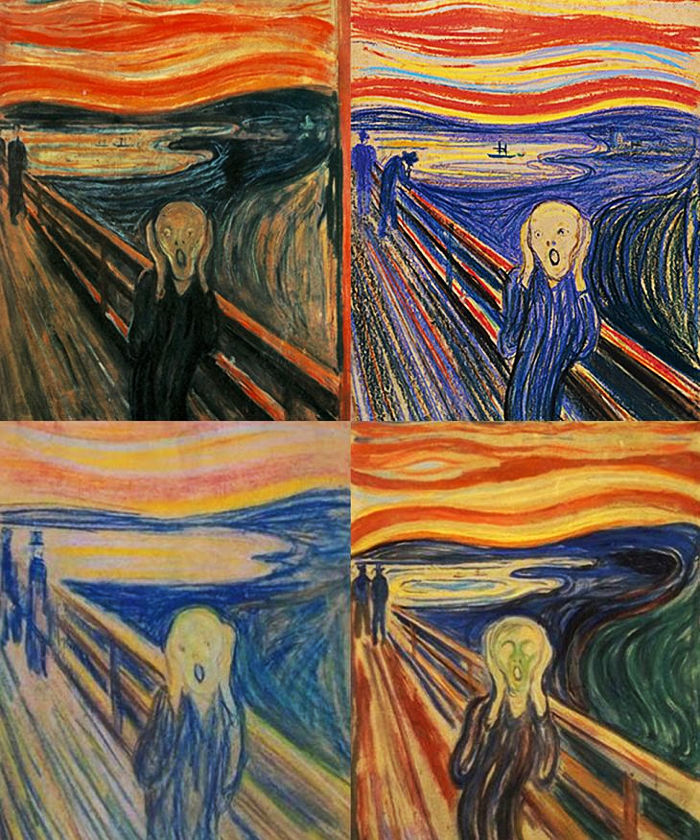
1. The 1893 version (National Gallery / National Museum of Norway, Oslo): Made with oil, tempera, and pastel on cardboard. It is the most famous version and the first to exist.
2. The 1893 pastel sketch (Munch Museum, Oslo): A quick, experimental take where Munch first tested the vibration of his brushstrokes.
3. The 1895 pastel version (Private Collection): Notable for the luminous intensity of its colors and for retaining the original frame, on which Munch wrote his poem about the sunset.
4. The 1910 version (Munch Museum, Oslo): Made in tempera on board, recognizable by its greenish tones and the spectral gaze of the central figure.
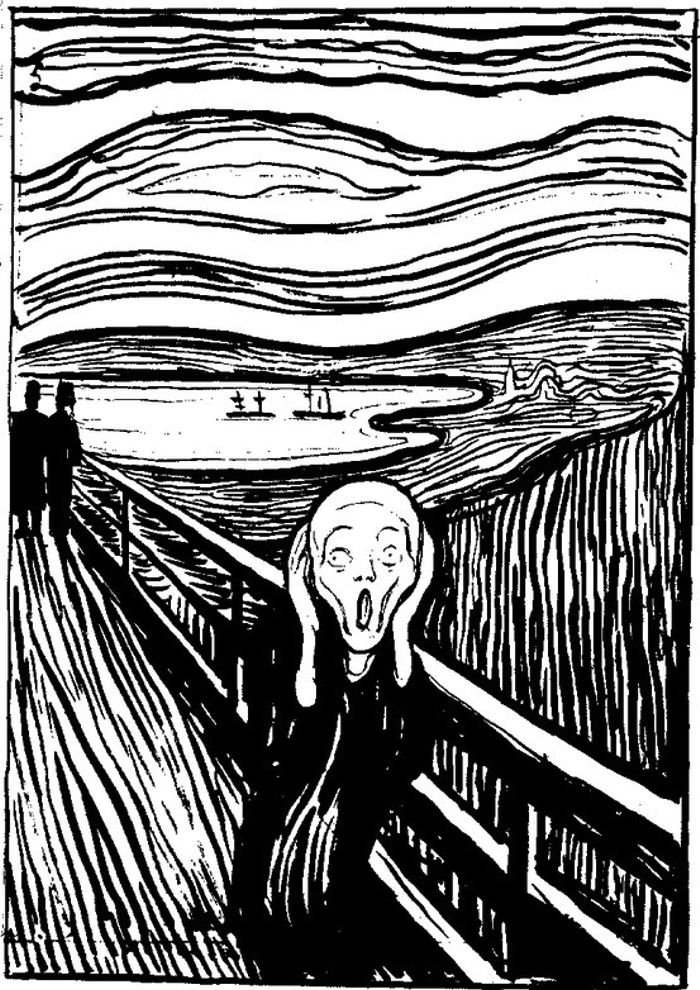
To these is added the 1895 lithograph, which allowed the image to circulate widely in magazines and avant-garde European publications, cementing Munch as the undisputed pioneer of Expressionist art.
The Collapse of Reality
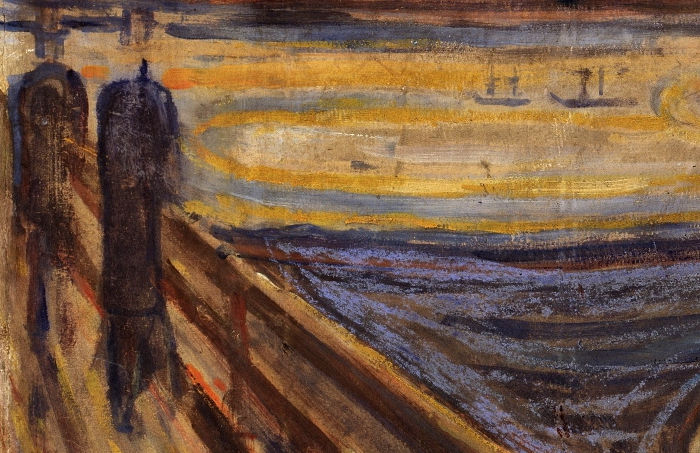
Munch deliberately abandoned the rules of academic perspective and naturalistic realism. Every element of the composition serves pure emotion:
The androgynous, universal figure: The character has no defined age, gender, or facial features. It is a skeletal, ghostly, wavering silhouette. By stripping it of any particular identity, Munch allows any viewer to see their own anguish reflected in it.
Lines in tension: The painting stages a violent geometric clash. The bridge railing cuts a rigid, piercing diagonal, while the sky, the fjord, and the figure's own body flow in liquid, distorted curves, as though matter itself were vibrating.
The abyss of isolation: The two walkers in the background continue on, upright, calm, and untouched by the sensory cataclysm. This visual separation underscores one of the most universal sensations of anxiety: feeling your world collapse from within while everyone else's routine carries on undisturbed.
The Red Sky: Emotional Memory or Krakatoa?
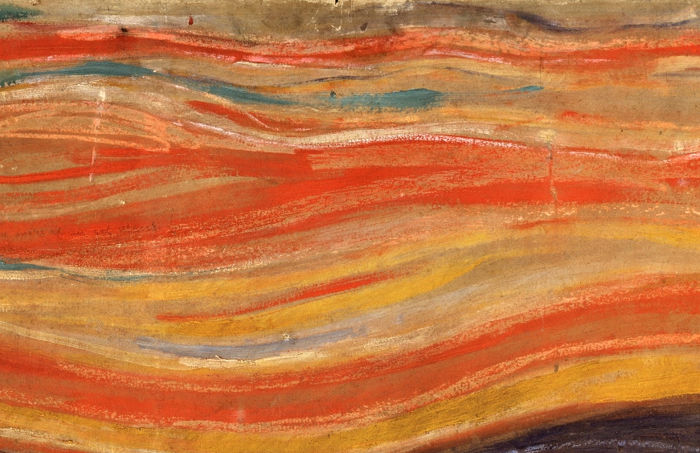
For decades, debate raged over whether the burning sky in the painting was purely a psychological metaphor or the recreation of a real meteorological phenomenon.
One of the most compelling hypotheses links Munch's palette to the catastrophic 1883 eruption of the Krakatoa volcano. The explosion hurled millions of tons of ash and aerosols into the stratosphere, which wrapped around the Earth for months, producing abnormally red, optically dramatic sunsets across Northern Europe.
Although Munch painted the first version a decade later, it is quite plausible that the visual impact of those skies from his youth stayed lodged in his subconscious, resurfacing when he needed to capture the exact color of panic.
The Mysterious Graffiti: "Could Only Have Been Painted by a Madman"
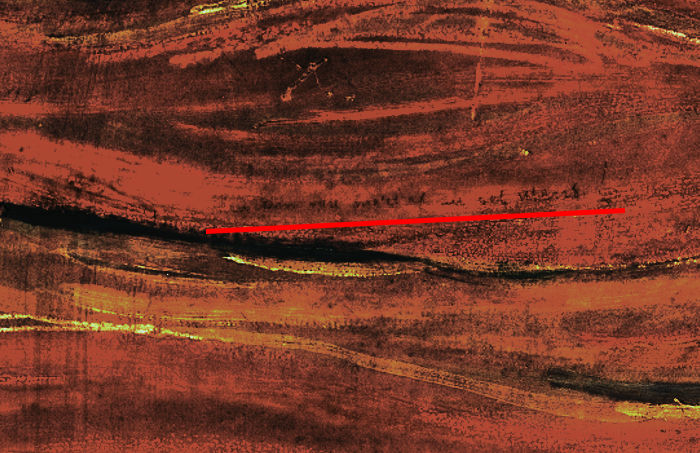
In the upper left corner of the 1893 version, there is a small, barely visible pencil inscription:
«Kan kun være malet af en gal Mand!» ("Could only have been painted by a madman").
For more than a century it was debated whether the line had been an act of vandalism by an outraged visitor at an exhibition. In 2021, however, an extensive infrared analysis conducted by the National Museum of Norway compared the handwriting with the artist's own letters and diaries. The result was conclusive: Munch himself had written the phrase.
Far from being a genuine breakdown, it was a bitter, ironic response to the scathing reviews of Kristiania's conservative press and to medical students who had publicly questioned his mental health after seeing his exhibitions.
Why The Scream Still Resonates Today
Edvard Munch was not trying to paint what the eye sees, but what the soul suffers: loneliness, grief over the early deaths of his mother and sister, heartbreak, and the fragility of the modern mind.
More than a century later, The Scream still captivates because it belongs to no single era. It stands as the definitive visual testimony of the human condition under emotional overload. Looking at the painting, the real question is no longer who is screaming, but something far more unsettling: who was able to hear the scream of nature?
THE ARTWORK
The Scream (Skrik)
Year 1893
Artist Edvard Munch
Technique Oil, tempera, and pastel on cardboard
Style Expressionism
Size 91 cm × 73.5 cm
Location National Gallery of Norway, Oslo, Norway