

A true icon of the Brera Art Gallery, Francesco Hayez's Kiss was once used on a well-known chocolate brand's boxes to celebrate Valentine's Day. Painted by Hayez at the age of seventy, the work stood out immediately for its sensual charge in an era that was still puritanical.
The famous Kiss by Francesco Hayez was commissioned by Count Alfonso Maria Visconti and presented at the annual exhibition of the Brera Academy of Fine Arts in 1859, just three months after the triumphant entry into Milan of Vittorio Emanuele II and his ally, French Emperor Napoleon III, who had joined the Lombard-Piedmontese army to achieve Lombardy's independence from the Austrians.
A Commission With a Double Intention
Far from being a spontaneous idea of the painter, there is evidence that the political message was part of the original request. Count Visconti was well aware of Hayez's commitment to the Italian patriotic cause, and the painter was already considered, in the words of Giuseppe Mazzini himself, the "chief of Historical Painting demanded by the national spirit in Italy."
The context was no small matter: under Austrian rule, the secret organizations pushing for Italian unification were ruthlessly persecuted and suppressed. Speaking openly of rebellion could mean prison, or worse. Hayez, moving in the same patriotic circles that conspired against the occupier, found in historical and sentimental painting a safe way to say what could not be said aloud: he disguised the conspiracy and the struggle against the invader beneath the surface of an innocent romance.

A Farewell, Not a Meeting
Acquired by the museum in 1887, the seemingly simple and immediate painting actually conceals a patriotic reading and does not merely depict two lovers exchanging a passionate kiss. Everything in the scene suggests urgency and farewell, not encounter.
The young man's bent knee, his foot already resting on the first step, is not a tender gesture: it is the posture of someone about to leave. It is as if the young woman had just come down from her chambers only to catch this final moment with him before he departs toward an uncertain fate.
On closer inspection, the dagger at the young man's side protrudes from beneath his cloak, pressing against him threateningly even in the midst of the loving embrace — a silent reminder of the danger awaiting him the moment he steps through that door.
Two Flags in a Single Embrace
The most fascinating detail of the painting lies in the colors of the clothing. Blue, white, red, and green: four colors that are not there by chance, but because they belong to two flags at once. The light blue of her dress, the white of both their cuffs, and the red of his stockings recompose the colors of France; that same white and red, together with the green present on the collar of the young man's cloak, recompose the colors of Italy.
The colors do not stand apart: they blend, just as the bodies of the two lovers blend together. It is a visual way of saying what, in 1859, no one could say out loud: the secret alliance between the French Empire and the Kingdom of Sardinia-Piedmont against Austrian rule.
That alliance had names attached to it. Napoleon III of France and Camillo Benso, Count of Cavour, secretly sealed the pact that, months later, would trigger the Second Italian War of Independence. Where the general public saw a romantic and harmless kiss, many Italians immediately recognized the alliance between France and the kingdoms of Piedmont and Sardinia, united to face the Austrians together.

The Shadow on the Staircase
To the left of the composition, a figure remains almost hidden in the shadows of the staircase: a maid, recognizable by the bonnet on her head, withdrawing with her back to the scene. Her presence adds a touch of mystery and discretion — she may well have been the one who made this stolen encounter possible, guarding the couple's privacy as she quietly slips away.
Far from a decorative detail, this figure reinforces the furtive and dangerous nature of the encounter: everything in the scene, from the lovers' posture to the presence of someone watching over their intimacy, points to a love that must remain hidden.
History Disguised as Sentiment
The canvas was immediately interpreted by Milan's cultured bourgeoisie in this political sense, symbolically framing the simple, eternal, everyday yet profound gesture between the two young people as the farewell of a patriot departing for a military undertaking.
During the 1850s, the artist faced criticism from those who accused him of painting history rather loosely, giving greater weight to feeling and affection than to objective historical accuracy. But it is precisely that freedom — setting the scene in a vague fourteenth century, with period costumes and no explicit reference to 1859 — that allowed Hayez to say, without saying it, what millions of Italians felt at that moment.
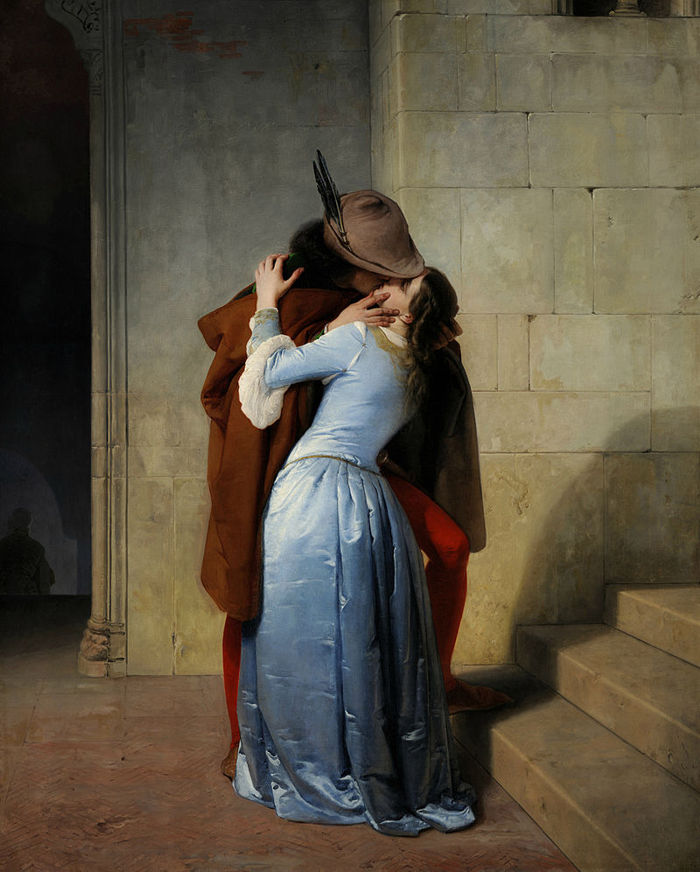
The painting became a symbol of Italian unification, and likely helped cement its final success just two years later, with the proclamation of the Kingdom of Italy in 1861. What looked like a simple romantic kiss turned out to be one of the boldest — and best disguised — political statements in nineteenth-century painting.
We invite you to enjoy a video featuring works in which the kiss takes center stage.
THE ARTWORK
The Kiss (The Kiss. An Episode of Youth. Costumes of the 14th Century)
Artist: Francesco Hayez
1859
Technique: Oil on Canvas
Dimensions: 110 x 88 cm.
Museum: Pinacoteca di Brera
Milan, Italy
pinacotecabrera.org